


Celebrating Charlotte’s 250-year-old spirit
by Gayvin Powers
This May, the phrase “MecDec” will be popping up all over town. It isn’t the latest app, or a trending dance on TikTok. It’s the Mecklenburg Declaration of Independence, written by some of Charlotte’s most respected leaders and signed on May 20, 1775. That’s right, local rebels declared themselves “free and independent” a whole 15 months before the Declaration of Independence on July 4, 1776. The MecDec — aka “MeckDec” or “Meck Dec” — is Charlotte’s story.
MecDec lore is full of treasonous letters, political intrigue and bare-knuckled brawlers. The local Scots-Irish militia developed a fierce reputation given to them by Gen. Cornwallis in the Revolution, who’d burned Charlotte, dubbing it a “hornet’s nest.” That was long after 1775, when local settlers had reached a breaking point from unjust taxation, a double-cross from King George III that denied their children an education, and the heavy loss of life at the Battle of Lexington. This is the story that put backcountry Charlotte into the forefront of the Continental Congress and the king.
If you’re unfamiliar with the MecDec story, here’s a quick recap: On May 19, 1775, locals had gathered at the Mecklenburg County Courthouse when the brutal news of the Battle of Lexington was announced. They debated until 2 a.m., ending with a response that was life-altering: They’d created their own Mecklenburg Declaration of Independence. At noon on May 20, Col. Thomas Polk read the MecDec by the courthouse door. This simple, passionate act set in motion a series of accusations, denials and betrayals that has haunted the United States for 250 years, making the MecDec the first U.S. conspiracy theory.
While some challenge the existence of the MecDec, we do know with certainty these five indisputable facts.
One: Twenty Mecklenburg Resolves outlined their independence from King George on May 31, 1775. While the Resolves are said to be a part of the MecDec, their full meaning is unclear. The Resolves were confirmed, but the MecDec, because no original copy exists, is based on eyewitness testimony only.
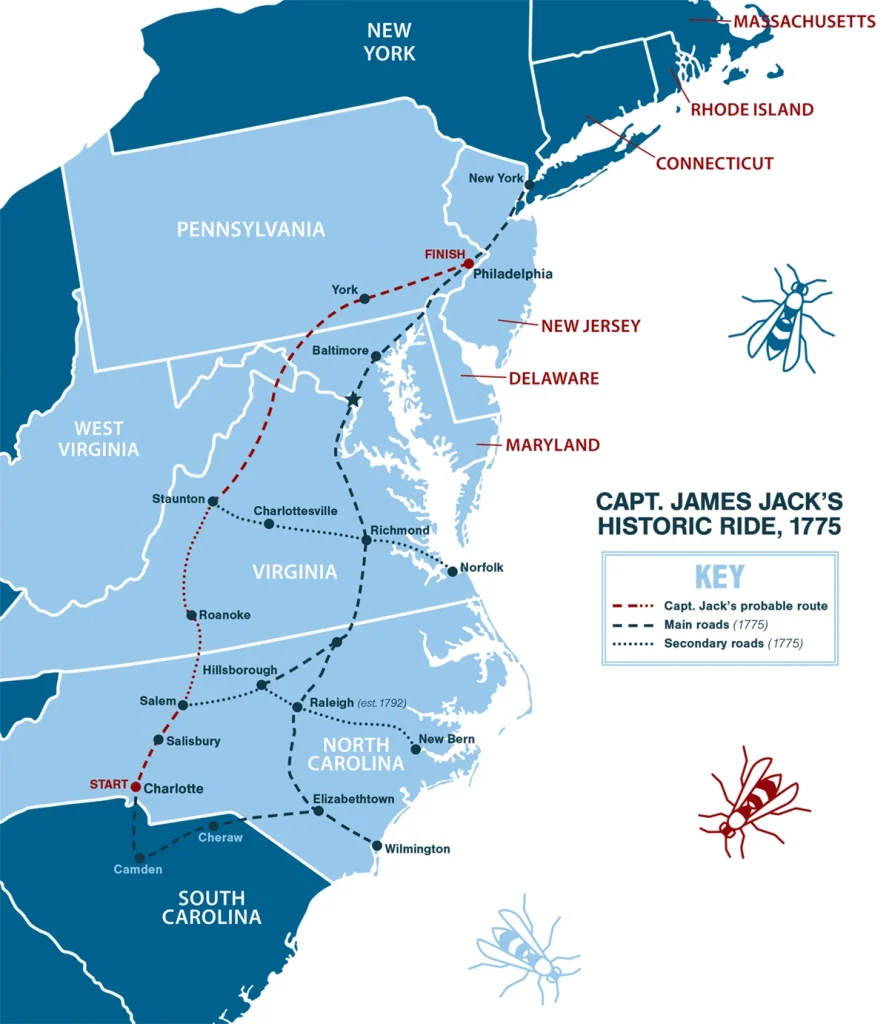
Two: Capt. James Jack, owner of a local tavern, was charged with delivering four letters (either the MecDec or the Resolves) to the Congress in Philadelphia. He arrived in Salisbury on his first day of riding. At the General court, Col. Kennon read the MecDec (or Resolves) into record.
Three: Jack’s ride is confirmed by Royal Gov. Josiah Martin, who referenced the Resolves in a letter to the Earl of Dartmouth on June 30, 1775.
Four: Captain Jack rode 550 miles with the British Army and loyalist militia patrolling land. If he were caught, he would’ve been hanged in the gallows. Every person listed on the documents he carried, including his family, would have been killed and their lands confiscated. A perilous journey indeed, considering that Paul Revere was caught after 12 miles, and Captain Jack rode 50 times Revere’s distance in hostile territory.
Five: While in Philadelphia, Jack delivered two copies of the letters to William Hooper and Richard Caswell, North Carolina delegates. Two more copies were left — one for Joseph Hughes, the third N.C. delegate, as well as one perhaps for the house speaker.
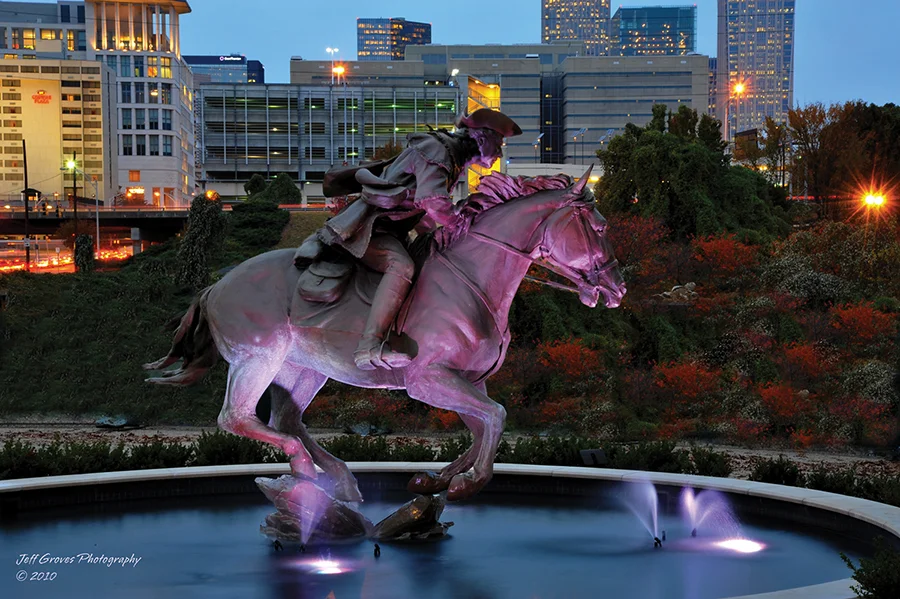
“The Spirit of Mecklenburg” by Charlotte sculptor Chas Fagan depicts Capt. James Jack’s historic ride. The statue was unveiled in May 2010 near uptown. Photograph by Jeff Groves Photography
Meanwhile back in Mecklenburg, the countrymen hadn’t known the Congress had extended an olive branch to King George, hoping for reconciliation following the battles of Lexington and Concord. Following Congress’ actions with the king, Captain Jack received a letter that claimed Mecklenburg’s declaration was “premature.”
Dissension traveled fast. Mecklenburg was the first, but not the last town, to draw up Resolves in 1775, including Wilmington and others. The political climate in North Carolina, known for being almost impossible to govern, had reached a boiling point, with Gov. Martin fleeing New Bern. On July 4, 1776, the Declaration of Independence was signed.
Years after Captain Jack’s harrowing ride, attempts to uncover precisely what documents he presented to Congress (the MecDec or the Resolves) have taken writers, historians and other curiosity-seekers down a million and one rabbit holes, involving espionage, slander and various presidents.
If Cornwallis thought Charlotte was a “hornet’s nest,” a swarm awakened in 1819 when John Adams, the second U.S. president, read a reprinted article about the MecDec in the Essex Register. He quickly rattled off a letter poking at his frenemy, Thomas Jefferson, the third U.S. president and author of the Declaration of Independence. The implication was that Jefferson had plagiarized parts of the MecDec in writing the Declaration of Independence. “Had I known about it, I would have commented upon it from the day you entered Congress till the fourth of July, 1776,” Adams wrote.
In his response on July 9, Jefferson stated that he believed the document was “spurious.” But, it was too late — Adams had already sent another letter on July 15 to Rev. William Bentley, stating that Jefferson “has copied the spirit, the sense, and the expressions of [the MecDec] verbatim, into his Declaration of the 4th of July, 1776.”
The confrontation between Adams and Jefferson fueled a juicy debate between the two emotionally charged men, with their integrity at stake. Although overwhelming personal testimony and oral history were in favor of the MecDec, it was also a moot point since the original document was destroyed in a house fire on April 6, 1800.
But the MecDec’s story doesn’t end with a fire and two bickering presidents. The hoopla about it had become so publicly heated that in 1831 the N.C. legislature set up a MecDec commission to investigate its legitimacy. The commission found that the MecDec was true.
Despite the commission’s results, several eyewitnesses and historians who’ve praised its rich oral lore, people still agree and disagree about the MecDec’s legitimacy.
You decide. Here are several unresolved threads that still exist regarding the MecDec.
TOP 7 UNRESOLVED DETAILS
One: Historians dispute what was in Captain Jack’s satchel. The document he carried was read into record in Salisbury. Where is the record? According to Scott Syfert, author of The First American Declaration of Independence? The Disputed History of the Mecklenburg Declaration of Independence of May 20, 1775, it was already resolved. “Why would you need to go to Congress with a message if it was nothing of importance?” Syfert says.
Two: It is believed that Captain Jack carried four copies of the MecDec. If three copies went to North Carolina delegates, who received the fourth copy? Did John Hancock, the first signer of the Declaration of Independence and the house speaker, get a copy? Where is the copy today?
Three: Syfert uncovered a Raleigh Register and North-Carolina Weekly Advertiser article that republished a toast given at a Charlotte celebration for President Jefferson’s election in 1801. The toast states, “The citizens of Mecklenburg, being the first in their Declaration of Independence, may they ever be the first in resisting usurpation by defending their civil rights.” To Syfert, it confirms the local belief of the MecDec.
Four: Recently, Syfert discovered the Marquis de Lafayette, on a tour of the United States in 1824-25, gave a speech at the Governor’s Palace citing, “the State of North Carolina, its Metropolis, and the twentieth of May, 1775, when a generous people called for independence and freedom, of which may they more and more forever cherish the principles and enjoy the blessings.” Clearly, the MecDec was discussed publicly.
Five: “The Smoking Gun.” In 1837, Andrew Stevenson, the U.S. Ambassador to Great Britain, checked out a newspaper article on the MecDec by Gov. Martin in Dispatch 34 that had been archived in London.
Knowing this, David Fleming, Author of Who’s Your Founding Father? One Man’s Quest to Uncover the First, True Declaration of Independence, traced Stevenson’s footsteps to the British National Archives. He found that Dispatch 34 had two lines written in pencil that read, “A Printed Paper taken out for by Mr. Turner for Mr. Stevenson, August 15th 1837.” It was never returned.
Fleming continues, writing, “Stevenson, that red-headed son of a gun. He found it … He actually found the MecDec … Then he got rid of it.”
If Stevenson found information that absolved Jefferson of plagiarism, why wasn’t it published? Why did the MecDec article in Dispatch 34 disappear?
Six: If the MecDec was a “hoax,” as some have said, why did four presidents and a first lady visit MecDec celebrations? Those dignitaries include William H. Taft in 1909, Woodrow Wilson in 1916, Dwight D. Eisenhower in 1954, Lady Bird Johnson in 1968 and Gerald Ford in 1975. Why was the MecDec date placed on the state flag? Or the Great Seal of North Carolina?
Seven: If North Carolina’s commission in 1831 confirmed that Mecklenburg first declared independence, why isn’t it well-known or widely celebrated in the 21st century?
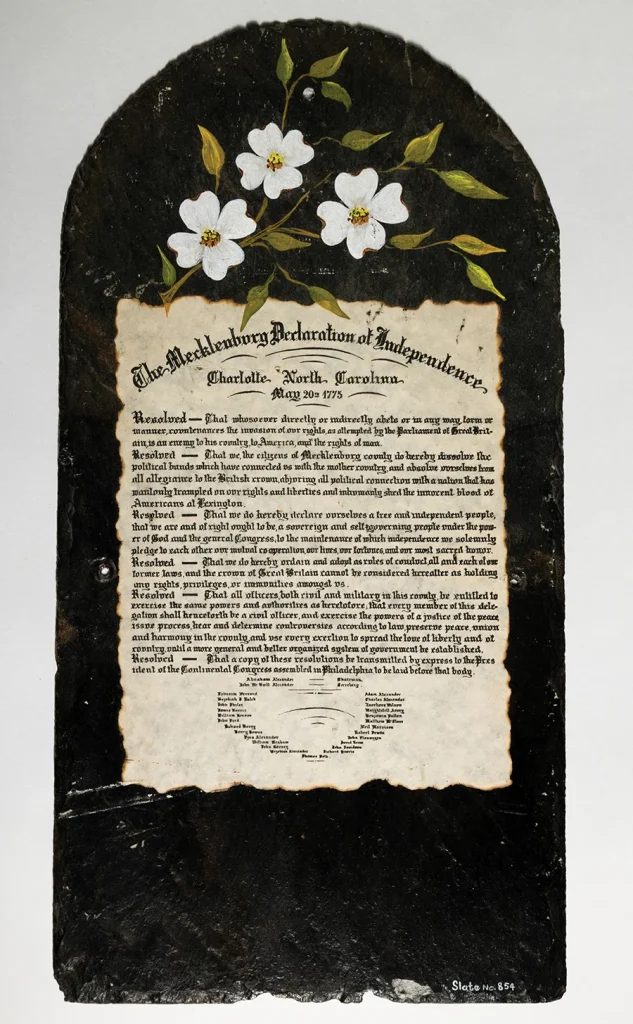
A MecDec marker, which will be on view at the Charlotte Museum of History as part of the Meck Dec 50 exhibit opening May 22. Photograph by Joshua Komer, courtesy of Charlotte Museum of History
Perhaps in time, those unresolved points will be answered.
What is certain is that Charlotte carved out her identity during a fragile time in history. Its leaders unified to protect their families, becoming a legendary hornet’s nest. They risked everything by adding their names to a declaration that could’ve signed their death warrants. They signed anyway.
Today, many are still unaware of Charlotte’s rich history and sacrifices that turned a backcountry village into a modern city. Syfert says it best: The history “gives you a sense of grounding about Charlotte that you wouldn’t have otherwise. It’s the authentic story of Charlotte.”
May is the perfect time to rediscover the rebels who declared themselves “free and independent” 250 years ago — before it was popular. Take a walk through Charlotte’s legendary past. Grab a pint of Captain Jack pilsner at Olde Mecklenburg Brewery, stroll down Little Sugar Creek Greenway to see his statue by Charlotte artist Chas Fagan, or listen to a reading of the MecDec at Independence Square on May 20. SP
WANT TO CELEBRATE THE MECDEC? Nine events around Charlotte.
AUTHOR’S NOTE: A special “thank you” to Scott Syfert, who helped this new-to-Charlotte author navigate the MecDec’s multilayered web. The MecDec has so many tendrils, it’s easy to get lost, spending countless hours digging through the archives. The topic questions the fabric of what is known about history and a once beloved president whose character is called into question. It’s also a great reminder about how ordinary people do extraordinary acts that make history.
REBEL READING
Read more of Charlotte’s fascinating history by local authors.
The First American Declaration of Independence? The Disputed History of the Mecklenburg Declaration of May 20, 1775
by Scott Syfert
Who’s Your Founding Father? One Man’s Epic Quest to Uncover the First, True Declaration of Independence by David Fleming
Mecklenburg, First and Forever Free, a children’s book by Julie Lentz Fogg and illustrated by Jolenna Mapes