


by Amanda Lea
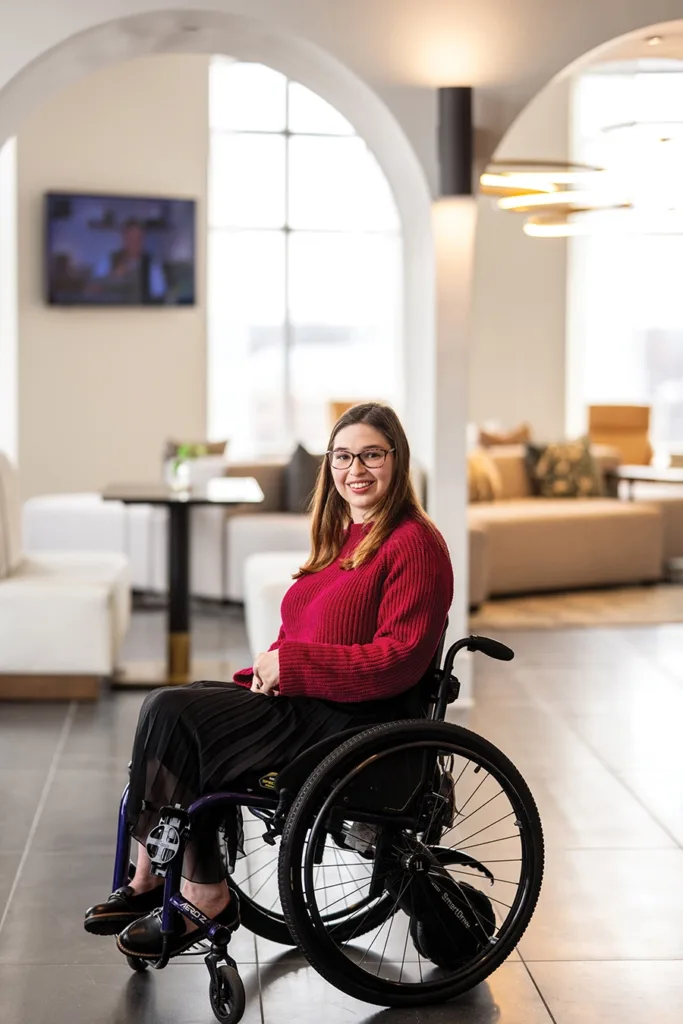
As 33-year-old Rebecca Combs looks out the window from her new apartment in SouthPark, she can see the stretch of land where her grandmother’s house once stood. The view is a reminder that while her Charlotte roots run deep, she is also stepping into something entirely her own.
“When I look out my window, I can feel her here with me,” Combs says. “It reminds me of who I am and who I am choosing to become.”
Combs is a fourth-generation Charlottean and a Providence High School graduate who now lives a mile from where her mother grew up in a home on the former Morrocroft farm. Her connection to the city is strong, but her faith in herself has been fiercely earned.
Opening doors
Diagnosed with scoliosis and cerebral palsy when she was just a year old, Combs has spent her life navigating surgeries, therapies and the everyday logistics of living with limited mobility. She has used a wheelchair since childhood and relied on her family for support, but that reliance never limited her ambition.
Attending college at the University of Alabama was a turning point for Combs. She found a community of friends with a range of abilities, including a Paralympian who became one of her closest friends.
“It was my first time being around such a large group of people, and many of them were like me,” she says. “It gave me a huge confidence boost.”
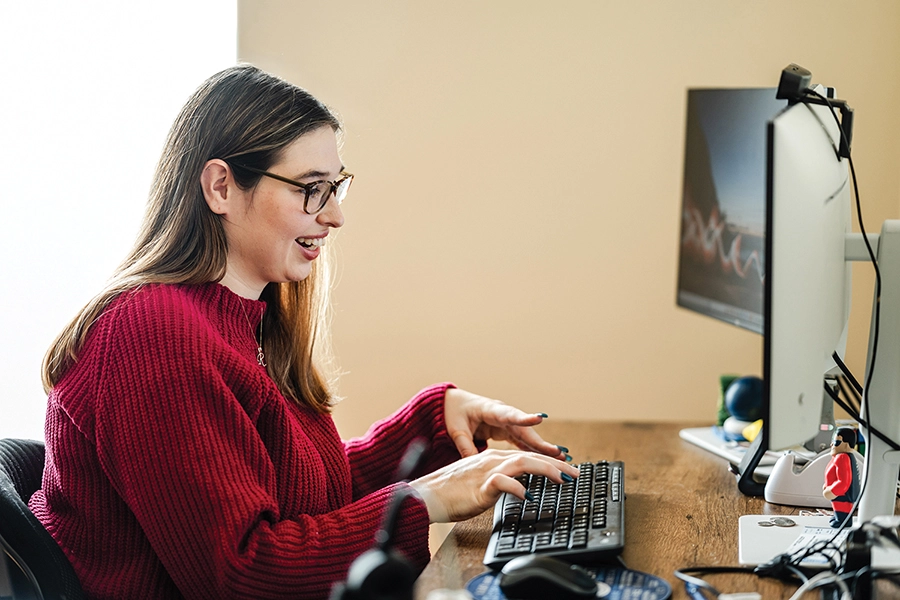
After graduating with a degree in accounting, she spent several years working at the YMCA of Greater Charlotte before transitioning to a remote role processing workers’ compensation claims. The job offered flexibility and stability, but a long-held goal remained: She wanted a home of her own — a place where she could build routines, make decisions independently and live life on her terms.
Time to fly
In 2024, she decided it was time.
“My sister got engaged and was starting her next chapter, and I realized I was ready to do the same,” Combs says. “I wanted to spread my wings and live on my own.”
To prepare, Combs began occupational therapy to build the everyday skills she would need to live independently. Sessions focused on using the oven, knife skills and learning how to pace tasks throughout the day.
“I needed to learn how to do all the things that make daily life work,” Combs says. With that foundation in place, she made her first solo medical decision.
“Growing up, my parents were always the ones making those decisions for me,” Combs says. “This was the first time I made one completely for myself.” She chose to undergo hyperselective neurectomy, a specialized surgery aimed at improving movement in her hand and arm. For years, tight muscles in her left arm caused her thumb to pull inward, limiting her grip and making everyday tasks harder. The procedure targets the nerves responsible for that constant tension and reduces their signals so the hand can move with more freedom and control.
“It was a big surgery with a lot of risk,” Combs says. “But I knew it was the right choice for me.”
She had the procedure in May 2025, followed by six weeks in a cast and another round of occupational therapy to rebuild strength and function. The recovery was slow, but it strengthened her confidence in living on her own.
“I knew my goal was to live independently, and this felt like the best way to move toward that,” she says.
Room to grow
While recovering, she began searching for an apartment that would be a good fit for her needs, but she quickly encountered challenges. Many places advertised as accessible did not truly meet her needs.
“A lot of apartments checked the box on paper, but in reality they just did not work,” Combs says. “There were bathtubs instead of roll-in showers, or layouts that would not work for me. Some places were too big or too expensive. It was discouraging.”
Then she found The Residence at SouthPark.
“From the moment they picked up the phone, it felt different,” Combs says. When she toured the apartment, still recovering, she immediately noticed the open layout of the bathroom and the space to move comfortably. Staff also worked with her on adjustments like installing a countertop microwave and adding grab bars.
“There have only been a few moments in my life when I just knew something was right,” Combs says. “The first was when I first saw Alabama’s campus. The second was being in this apartment.”
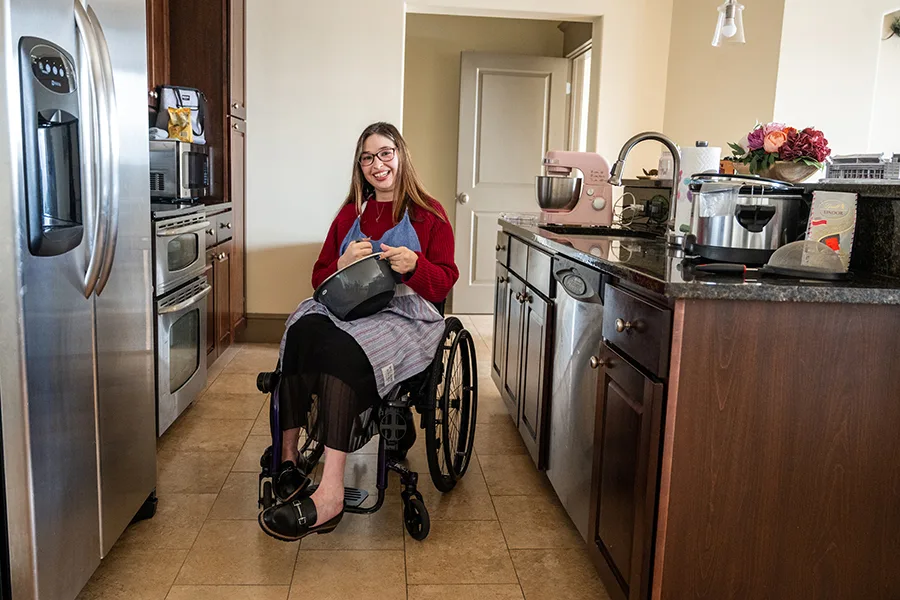
In June, she moved in, and everything shifted. For the first time, Combs could set her own routines, cook her own meals and enjoy the everyday independence she had long imagined.
“Sometimes I just roll around thinking, this is mine. I am doing this,” she says. “It feels silly to be so proud of something many people do earlier in life, but that wave of pride hits me every time.”
Even after settling in, Combs continued working toward greater independence. In fall 2025, she had another procedure on two of her fingers to make everyday tasks a little easier.
“It’s made a big difference,” she says. “Every bit of movement I gain helps me do more on my own.”
Finding freedom
Living alone also brought some anxiety. Combs grew up with three sisters and was used to having people around. Her family still lives just 15 minutes away, and nightly phone calls while she cooks dinner help maintain that closeness. At the same time, she has begun building a new community. Neighbors have slipped notes under her door offering help. She attends events at the apartment complex and has already made friends.
She also credits the SouthPark Skipper service, which provides wheelchair-accessible transportation around the neighborhood.
“For someone who doesn’t drive, it gives me more independence to run errands, meet friends, or just get out and about on my own,” Combs says.
Her advice to others navigating similar barriers is simple: “Do not settle,” Combs says. “Be clear about what you want, and be patient. Trust that it will work out.”
Balancing work, health and home life continues to be a learning process.
“Every task takes energy,” she says. “I’ve had to learn how to protect it.” Timers, a robot vacuum and structured routines help, but so does giving herself grace. “I can decide when I want to cook dinner or watch the sunset,” Combs says. “That freedom matters more than people realize.”
The next chapter
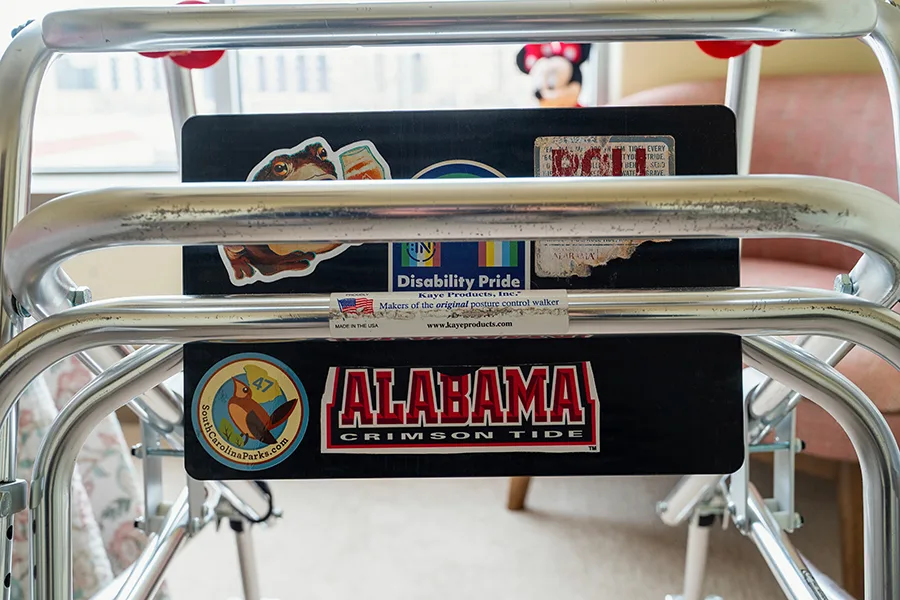
Outside of work, Combs enjoys cooking, volunteering with the Special Olympics and helping in the nursery at St. Gabriel’s Catholic Church. Working on puzzles and building Lego sets helps her improve hand-eye coordination. She is also a devoted Alabama football fan.
“I could tell you more about football than you would ever want to know,” Combs says.
Over the holidays, she decorated her first Christmas tree, a ritual she had long imagined.
“Turning on the lights at the end of the day just made me smile,” Combs says.
Looking ahead, Combs says she hopes to be a mom someday and would love a service dog, but for now she is proud of the life she is building.
“I had a goal, and I made it happen,” she says. “People have told me I can’t do things, and that is usually the best way to make me do something.”
With her family history woven into the city’s fabric, Combs feels an even stronger sense of belonging in a place she has watched grow and change. SouthPark has long been part of her family’s story, but this chapter is entirely hers. SP