


by Ross Howell Jr. | photographs by Richard Israel
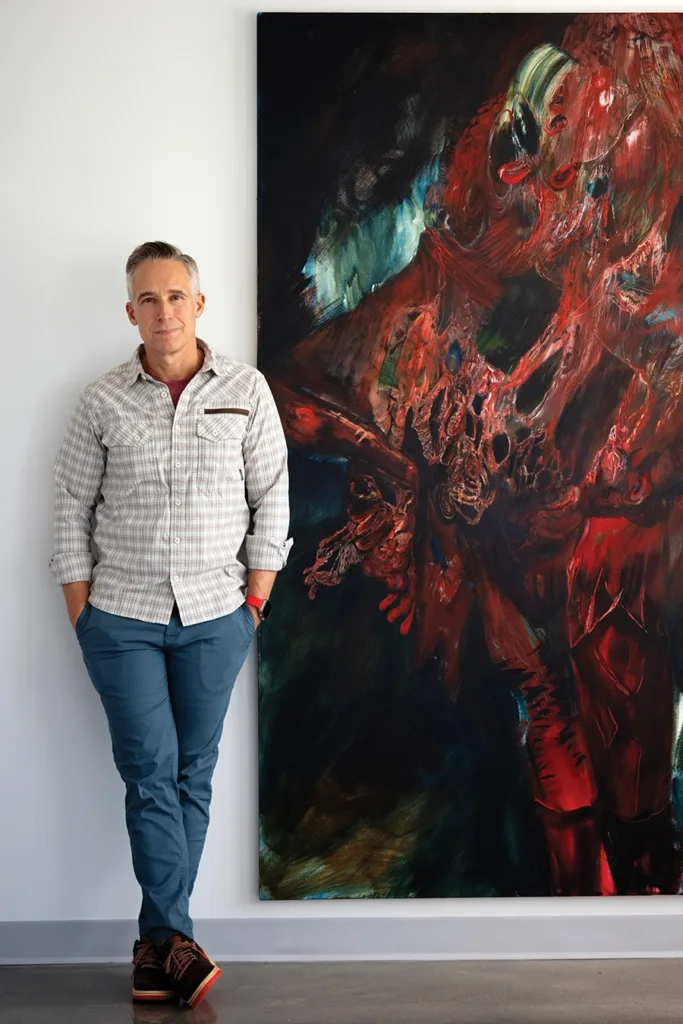
This past January, Jonathan Justice was named chief strategy officer at Atelier 4, a fine-art logistics company that was founded 36 years ago in New York by Jonathan Schwartz. Over the years, the company — which stores, transports and installs fine art — has grown, adding facilities in Los Angeles, Miami, and more recently, Charlotte.
Joining A4 was a full-circle moment for Justice, a Queen City native.
“By the time I was 10 years old,” Justice says, “I could walk by memory through the collection of the Metropolitan Museum of Art in New York.”
Courtesy of his father.
“I can remember a time or two when he and I kicked a ball or threw a ball or shot baskets together, but that’s not what we did,” Justice explains, though in school he played both football and lacrosse.
“What we did was go to museums,” he says.
His father had been raised by a single mother in Whiteville, a small town in southeastern North Carolina, amid difficult circumstances.
“They had to rely on the church for assistance,” Justice says. When his father left for college, he majored in English and art history. After graduating, he became a teacher, choosing English as a discipline since there were more positions available.
“But art history was his thing,” Justice says.
So every vacation, the Justice family drove to New York or Washington, D.C., visiting museums. As a teen, Justice believes he must’ve gone through the National Gallery of Art at least seven times.
“I grew up thinking that was normal,” he adds with a smile.
CAROLINA TO NEW YORK
Jonathan grew up in Fort Mill, South Carolina, and attended Charlotte Country Day School — his father was a teacher there, able to take advantage of the full tuition remission policy the school offered for the children of faculty and staff.
Country Day is known for a robust visual-arts program. In addition to college-prep courses, Justice took art-appreciation classes and even signed up for an AP art history course his junior year.
“That wasn’t really something a lot of kids did at the time,” Justice says. “But I loved it.”
After graduation, Justice entered UNC Chapel Hill as a Morehead Scholar. Like his father, he focused on English, creative writing and art history, studying with author and musician Bland Simpson, poet James Seay and the inimitable Doris Betts. He would’ve pursued a degree in art history, except the program required courses in 2D and 3D studio art.
“I knew that the world did not need to see any of my studio art,” Justice confesses.
While he spent most of his academic time in Greenlaw Hall in the writing program, he spent even more time at Hanes Art Center, where he worked as a docent.
“That was my favorite building,” Justice recalls.
After graduating, he embarked on the career path his father had followed, landing a job teaching English and history at West Mecklenburg High School. That’s where he met a young woman from Clemmons — fellow Carolina alum and English teacher, Amy Amazon. His second year of teaching, they were wed.
“We’ve since regretted not hyphenating our names, because Amazon-Justice would’ve been the greatest hyphenated name ever,” Justice laughs.
When he heard about a position at Sotheby’s in New York City, Justice decided to make a career change.
“I promised Amy we’d just stay in New York for a couple of years,” Justice says. “But you know, you get on that hamster wheel.”
For Justice, Sotheby’s job was an avenue into the art world, but his responsibilities lay primarily in business strategy and development, where he employed his writing skills — not his knowledge of art history.
“So, there I was, with this new career, in this new town and a new marriage,” Justice continues, “and I have this kind of back and forth going between the art world and the business world.”
And that pendulum seemed to swing farther from the world of art and closer to the world of private banking and wealth management.
After seven years at Sotheby’s, Justice was recruited by private-investment firm Sanford C. Bernstein (now AllianceBernstein), an iconic Manhattan firm.
“I made the change into banking to provide a different path for my family,” Justice says. “We had a 9-month-old, you know?” Still, he had the nagging feeling that he had “sold out.”
A NEW COURSE
Justice followed the investment path for 18 years — through the global financial crisis of 2008, through big bank mergers and acquisitions and the vagaries of the boutique-bank and wealth-management world. By any standard, Justice had a successful career in New York. He had a nice home in New Jersey, a daughter who was a freshman in college and a son who was a sophomore in high school.
And back in Fort Mill he had a father — the man who had opened his imagination to the art world — who needed him.
“My mom was pretty far along in dementia, and my dad had no one to help,” Justice says. Amy had been ready to return to Carolina from the time Justice first assured her that they would be in New York for only a short while.
“Within the space of a weekend, we made the decision to sell our house and move to Charlotte,” Justice continues. While his daughter was sad to move away from the New Jersey home where she’d grown up, the transition wasn’t so difficult. For his son, however, who was losing all his friends, it was very painful.
“So I called up the admissions director at Country Day, who’d worked with my dad,” Justice says. “And I asked her, ‘Do you have a spot for my son?’”
“And she answered, ‘Well, we have a spot for your dad’s grandson.’”
Justice muses for a moment and nods.
So, a new course was set. Justice hung his shingle as an investment consultant and began working with clients. Then one day, he had a phone conversation with Schwartz, A4’s CEO. Schwartz and Justice knew each other from New York, where Justice sometimes recommended Schwartz’s company to wealthy clients with art collections.
Schwartz thought Justice should meet with a wealth manager he knew in Charlotte because he believed the two would make an excellent team.
“So we met,” Justice says. Midway through their conversation, the wealth manager sensed that Justice was not keen about continuing in banking and had an abiding interest in art. She suggested that he talk with Schwartz about joining Atelier 4.
“I remember asking when I made that call, ‘Are you talking about me coming in-house?’ And Schwartz says, ‘I don’t know, am I? Do you want to?’” Justice laughs.
“We took a couple months to tiptoe into it,” he adds. “I started as a consultant.”
Now Justice serves on the management team of one of the premier art logistics companies in the world. A4 provides logistical, door-to-door support for museums, galleries, auction houses and collectors nationally and internationally. Because of the company’s knowledge and experience in the art world, A4 also consults with private individuals, commercial investment firms, and trusts and estates on art acquisitions and transfers.
As chief strategy officer, Justice is responsible for enhancing A4’s competitive and financial advantages and scaling out operations as opportunities present themselves. On a more mundane — but no less significant — level, Justice recently helped his parents downsize into a townhome near his house — and used A4 to move their art.
The best part of the story?
“My son recently started his senior year at Country Day,” Justice says. “That night, when we all sat down to family dinner, he said, ‘Today was the best first day of classes ever.’” SP