


The retired educator and author shares life lessons and talks about his legacy.
by Asha Ellison | photographs by Richard Israel
The morning I’m slated to interview Edward “Eddie” Bell begins like any other.
What sets the day apart is knowing I’m going to meet a man who is comfortable no matter where he goes or where he’s been in life. A man who writes so powerfully with his pen that it has inspired change even as far as the White House.
As I enter his SouthPark neighborhood, the January sun shines brightly over the community that he and Wilhelmina, his wife of more than 60 years, call home. Together, they have two children, a son and a daughter who have both flown the coop. Wilhelmina, or “Mina” as he endearingly calls her, is the first and only woman Eddie has ever written poetry for.
The two-story haven is the retired couple’s dream: It comes with warmer weather than their previous New York home, an ideal cost of living, and it’s the perfect size for the two of them.
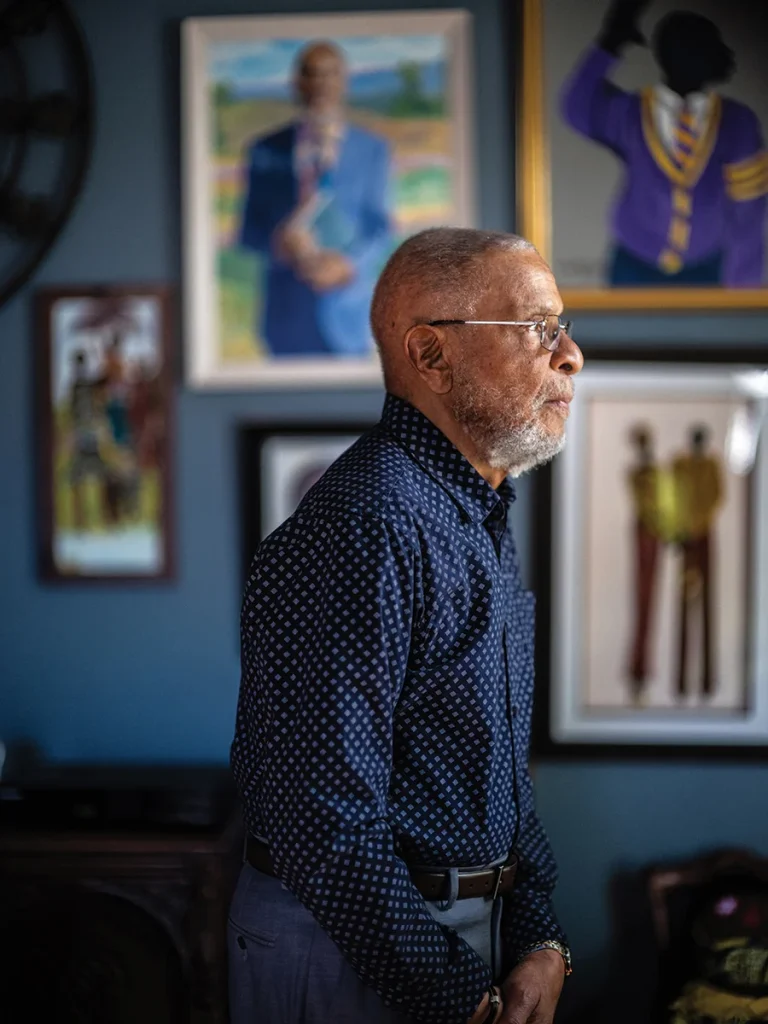
As I enter the home, Bell, a U.S. Air Force veteran known for his work as an author, poet, educator, freelance journalist and photographer, shepherds me into the living room — a museum of marvelous Black art, adorned with colorful paintings and cultural artifacts.
“Well,” I start, taking a seat on the couch beside Bell. “I didn’t prepare any specific questions. I just thought we could let the conversation flow.”
He is as open to this suggestion as he is tickled.
“Well, then,” he laughs heartily, “let’s flow.”

THROUGH THE YEARS
Eddie Bell was born in Chicago in 1939 and raised in Loves Park, Illinois, a member of the only Black family in the area at the time. There, on his grandparents’ farm, he discovered a love for gardening and poetry — gifts he inherited from his grandfather and mother, respectively.
Bell’s mother passed away when he was just a toddler. He fondly remembers moments when his grandmother shared his mother’s poetry with him.
“It was so important to me because it was a connection to her that wouldn’t reveal itself to me until I was older,” he says.
When he was just 7 years old, Bell’s father moved the family — Eddie, his brother and his “second mother,” an endearing term for his stepmother — to New York, where Bell remained until he graduated from high school. New York is also where he met the love of his life.
“[Mina and I] went to the same high school,” says Bell, grinning from ear to ear. “But I didn’t meet her until after I graduated.” Bell admits he wasn’t writing poetry professionally at the time, but he did woo his future wife with romantic words throughout their courtship.
After high school, Bell went to college at Tennessee State and Michigan State universities, joined the Air Force, got married, and taught at Howard University along the way. He and Mina moved to New Paltz, New York, in the mid-1960s, where Bell worked at the State University of New York at New Paltz for 28 years before retiring in 1994. The couple moved to Charlotte in 2013.
THE POWER OF POETRY
Bell didn’t experience his first Black teacher until he attended Tennessee State, a historically Black university. Surrounded by a community that reflected himself, one that differed from those where he grew up, brought joy and revelation. He started to write poetry again and even stepped into the world of performance and spoken word.
In the mid-1990s, after noticing a lack of Black art on a tour of the White House, Bell wrote a letter detailing his concerns about why representation in such prominent places matters. In the letter, he enclosed a poem he wrote about Black children playing on side streets — a poem so powerful it earned him a response and two invitations to the White House: one for a personal tour of the homes galleries and another to be a guest of honor when the Clinton administration purchased and unveiled its first selection of Black art, Henry Ossawa Tanner’s “Sand Dunes at Sunset, Atlantic City.”
In 2001, Bell published his first poetry book, a tribute to his father titled Capt’s Dreaming Chair. His subsequent work would explore everything from love and identity to relevant cultural topics such as the impact of racial violence on the Black community.

UNDULATIONS
In 2024, Bell released Undulations, his fifth — and most personal — anthology. In this poetic memoir, Bell sways and moves among the text, honoring ancestors and his own life experiences. Through this work of poems and narratives, he spotlights moments of personal and cultural significance.
Between the pages, readers will find rich commentaries on love, life and the challenges of aging (“The Gone”). Bell hopes readers will also appreciate his work on the importance of community (“Belonging” and “We’re Still Here: A Shoutout to Blackness”), racial reckoning (“Black Is My Being”), experiences with nature (“My Red-Breasted Visitor”) and spiritual redemption (“Confirmation of I AM”).
He also indulges art enthusiasts with his own original flower photography and incorporates works from artists such as Nellie Ashford and Kathryn Gantt to bring his words to life. This book, with a riveting foreword by Charlotte Poet Laureate Junious “Jay” Ward, is a healthy helping of some of Bell’s most notable work. The anthology took him two years to complete, from selecting the perfect pieces to layout and design.
SOMETHING NEW
As we come to the end of our conversation, a smiling Bell lets me in on a secret.
“I’m in the final rewrite of my first young-adult fiction book,” he says.
In 2023, Bell participated in Charlotte Lit’s Authors Lab program, in which he completed the novel that is now in its beta review stage. He is proud of himself for trying something new at his age, and he hopes the book will be the first of his works to be published commercially.
“Writing is the best way I can express myself,” Bell concludes. “It’s the ebb and flow of my life.” SP
Featured image: Eddie and Wilhelmina Bell in their SouthPark home.