


by Krisha Chachra
From coast to coast, Ireland’s lush landscapes, literary history and pub culture make it an ideal destination for an adult adventure. Castle hopping is popular — there are about 30,000 of them across the country — and the running joke is that tourists eventually tire of “ABC” (another bloody castle).
Only a handful have been converted into luxury accommodations. Ashford Castle, an 800-year-old stronghold in County Mayo, is perhaps the most famous. But on a recent couples’ trip, we discovered that Ireland’s true romance lies elsewhere: wandering into restaurants, singing along with live musicians, popping into museums and listening to stories in Irish pubs.
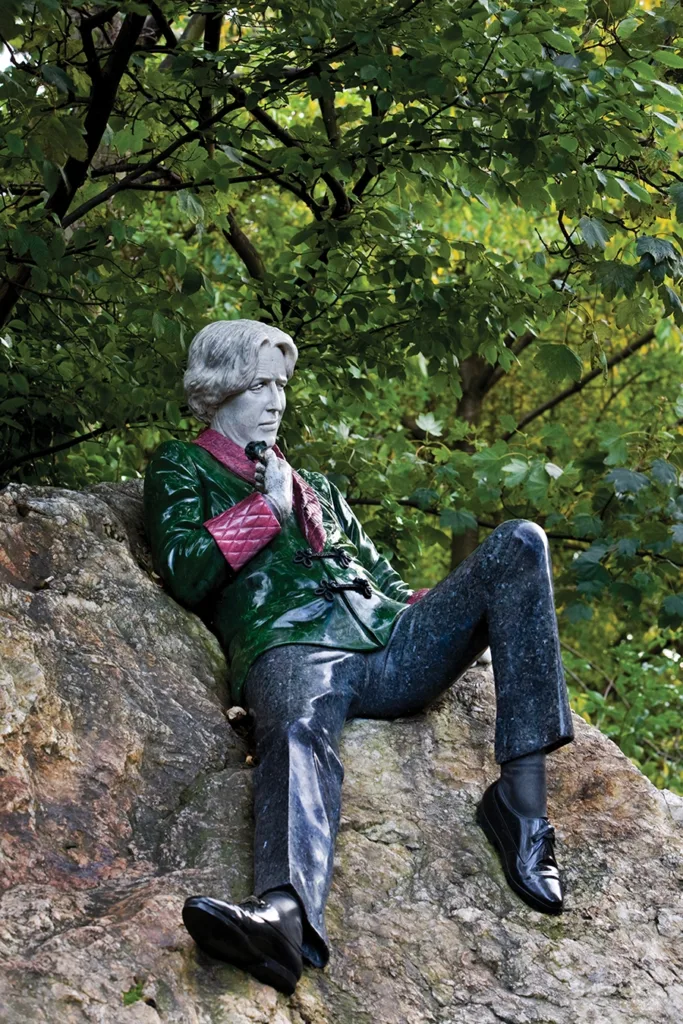
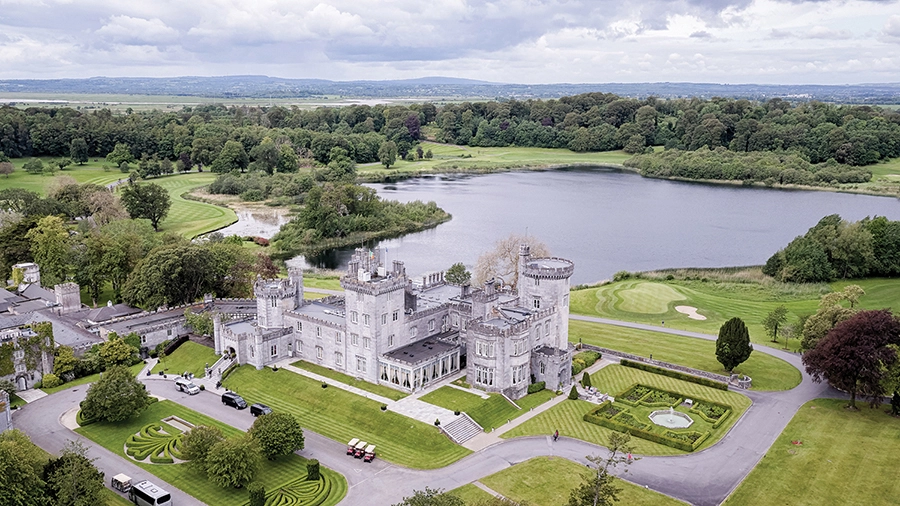
Oscar Wilde statue, Merrion Square and Dromoland Castle Hotel. Courtesy Fáilte Ireland.
Irish poet and playwright Brendan Behan once wrote that he was “a drinker with a writer’s problem.” After a few days in Dublin, it’s hard not to notice the inverse. Ireland is a nation of writers with a thirst — one that is quenched often.
Storyteller and tour guide Sean Cuddy explained that after gaining independence from Britain in 1922, Ireland was plunged into a painful civil war. Rather than glorifying the generals and politicians who remind them of this “embarrassing time in history,” the country honors its identity through art and language. Statues of James Joyce (at least four in Dublin) stand on street corners, Oscar Wilde reclines in a public park, and music spills out of pubs at all hours. It’s a culture that welcomes you in easily — especially if you’re willing to share a pint, a bowl of stew and a good story.
PINTS AND PASSAGES
For a spirited immersion into Dublin’s literary life, reserve a spot on one of the city’s famed literary pub crawls. Led by actors and professional storytellers, our tour unfolded more like a performance than a history lesson. Colm and John, longtime musicians and actors, guided us through pubs once frequented by Joyce, Wilde, Samuel Beckett, George Bernard Shaw, W.B. Yeats and Michael Collins, an Irish revolutionary and soldier. Between pints, they recite passages from Ulysses, read aloud letters between writers and lovers, and sing ballads that quickly turn into group singalongs. Dublin, they remind us, is a city where literature isn’t studied quietly — it’s “argued, sung, toasted and very much alive.”
We ventured out from The Duke to Davy Byrne’s to O’Neill’s, and onward to The Old Stand, sipping Irish whiskey and soaking in their stories.
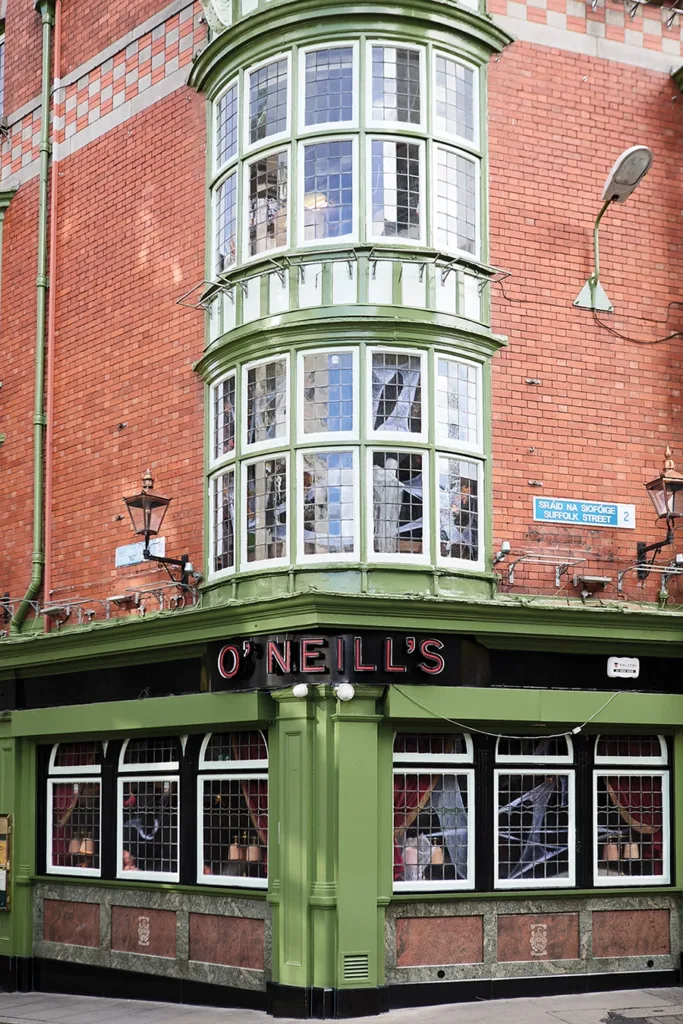
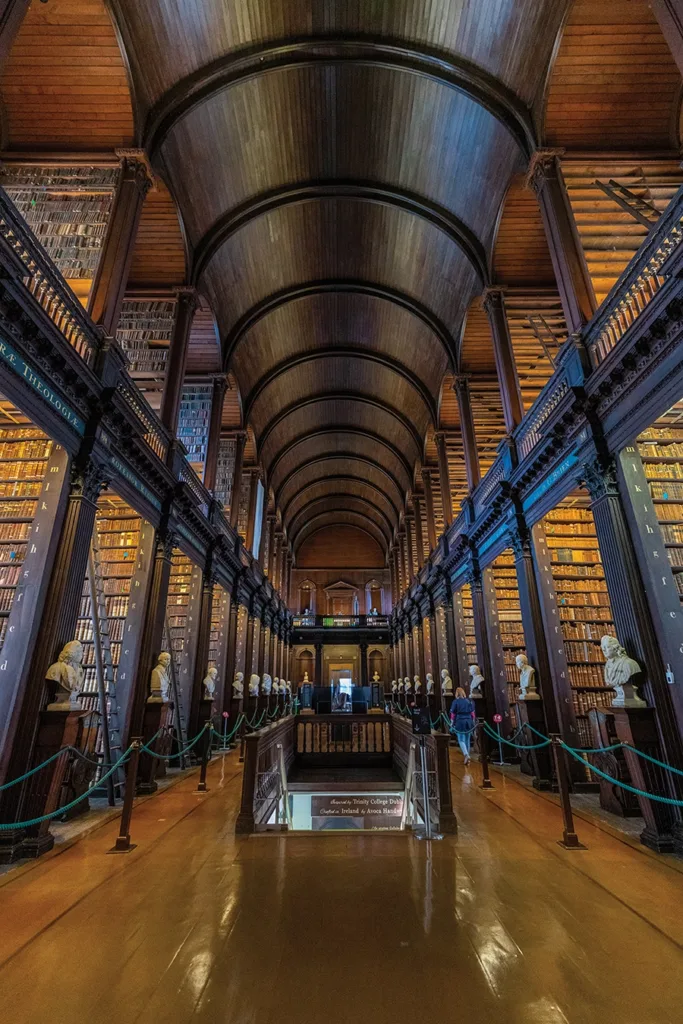
O’Neill’s Pub and Library of Trinity College. Photos by Theresa Aherne (O’Neill’s), Nuria Puentes (Trinity college) courtesy Tourism Ireland.
“All ballads are living ghosts,” Colm told us. “And all ghosts long for a living voice.”
Historic voices are preserved at Trinity College, one of the world’s oldest universities, founded in 1592. The Book of Kells, housed in the Long Room of the Old Library, has survived Viking raids, underground burial, theft and restoration. Written by monks around 800 A.D., the illuminated manuscript contains the four Gospels of the New Testament painstakingly illustrated and adorned by hand. Soon, the library will undergo major renovations, and the book will be temporarily relocated as preservationists digitize it in 3D. Marble busts of great thinkers that now line the Old Library will be replaced by talking holograms, debating their ideas and expertise with each other during the restoration.
No visit to Dublin is complete without a stop at the Jameson Distillery, offering insights — and samples — of the whiskey that defines Irish hospitality, or the Guinness Storehouse, which tells the story of a stout so iconic it’s synonymous with Irish identity. At the end of the tour, we posed for a photo later printed onto the foam of a perfectly poured pint — totally touristy and totally fun.
FROM CITY TO COUNTRYSIDE
After a few days in Dublin, we rented a car and ventured west, trading city streets for rolling countryside. Adjusting to driving on the left side of the road, we took it slow along the M7 motorway and paused in Limerick. At Katie Dalys pub, just steps from King John’s Castle (ABC!), we ordered pints and attempted to recite limericks — pulling from memory and the internet — earning applause from amused patrons.
The landscape unfurled like a green silk carpet as we arrived at Dromoland Castle. Constructed during the Renaissance and rebuilt in the early 19th century, the castle now operates as a luxury hotel, complete with tapestry ceilings, grand rooms and European elegance. Guests can golf, book spa and massage treatments on quartz tables, practice morning meditation, or learn falconry. At night, ballad singers perform by the fire, taking requests as guests sing along, nightcaps in hand.
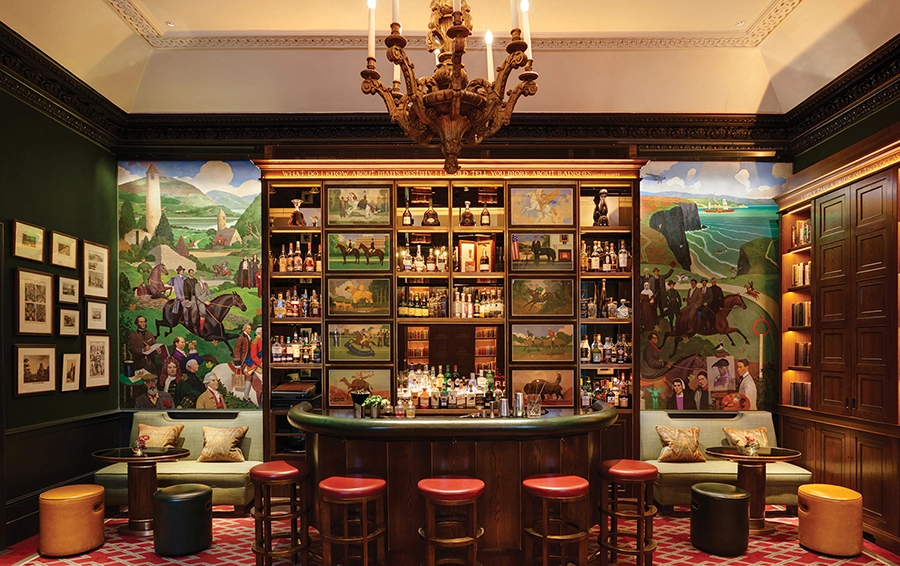
1824 Bar, The Shelbourne Hotel. Photographs courtesy Fáilte Ireland.
Just a short drive from Dromoland are the Cliffs of Moher. Climb the path that leads above the rock face and peer down at the Atlantic Ocean crashing below. As the wind whips violently around you, it is easy to feel fragile atop the towering cliffs. For a different perspective, we boarded a small boat from Doolin Pier, a private “seafari” with suspension seating to absorb the waves. From the water, the sea stacks — giant stones standing apart from the cliffs — appear otherworldly, their vertical faces dotted with nesting seabirds, their bases battered endlessly by surf.
The boat carried us onward to Inisheer, one of the Aran Islands, home to just 350 residents whose families have lived there for generations. We explored on foot and by horse-drawn carriage, visiting a famous shipwreck stranded improbably on the shore. Local lore suggests the iconic Aran sweaters were once knit with distinct family patterns so fishermen could be identified if lost at sea.
A LITTLE SONG & DANCE
Continuing north, we stopped in Galway, the cultural heart of western Ireland. A stay at Glenlo Abbey offered emerald fairways, manicured gardens and a dining-car restaurant housed in a vintage train. In the city, medieval walls frame the world famous pastel row houses along the river, while fast-footed dancers take center stage at Trad on the Prom — a local showcase of dancers who once toured with Lord of the Dance or Riverdance. International flags fly above the Latin Quarter in a nod to Galway’s global population, and renowned writers’ statues appear again — on benches, in parks, on bustling corners.
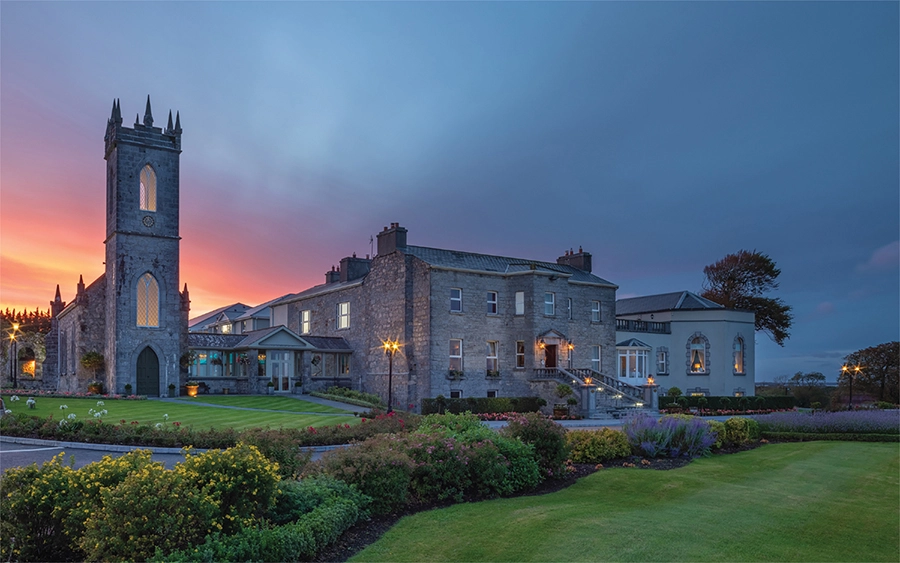
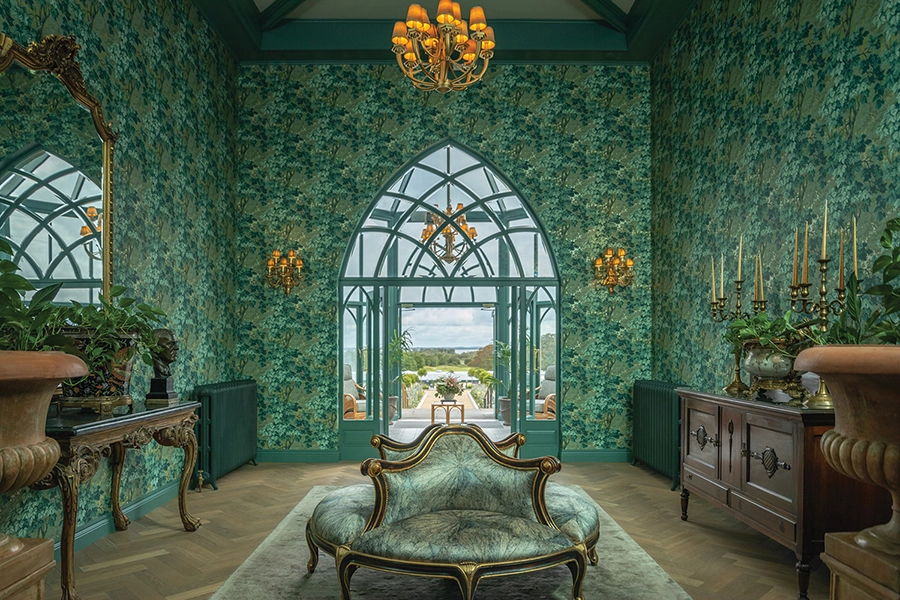
Glenlo Abbey Hotel & Estate and The Tapestry lounge. Photographs courtesy Fáilte Ireland.
Returning to Dublin, we made time for the National Museum and the National Library of Ireland, home to a permanent W.B. Yeats exhibit. On our final night at The Shelbourne, we wandered downstairs to the 1824 Bar, once again enveloped by literary quotes on the walls. Brendan Behan’s words echoed once more: “I only drink on two occasions — when I’m thirsty, and when I’m not.”
Thirsty for one last taste of Ireland, we ended at Temple Bar, where a Joyce statue stands guard at the entrance as musicians lead singalongs inside. Strangers press shoulder to shoulder, voices belting out familiar Irish bar songs. Don’t worry if you arrive alone — here, they’ll tell you, there are no strangers. Only friends you haven’t met yet. SP