


Taking up space: In a new exhibition at Davidson College, Elizabeth Bradford’s vivid canvases offer a distinctive perception of the natural world.
by Jay Ahuja
Lia Rose Newman, director and curator of Van Every/Smith Galleries at Davidson College, felt it was time to get back to nature. Enter Elizabeth Bradford’s Warp Weft Water Weeds solo exhibition, on view Feb. 13-April 9. In her paintings, the Davidson resident draws inspiration from outdoor settings, primarily across the Southeast.
“We had known and admired her work,” Newman says. “It expresses a deep message about conserving the land and what nature can do for us.” The exhibition is also about recognizing one of Davidson’s own. “It was important to honor her work over the past 50 years,” Newman adds.
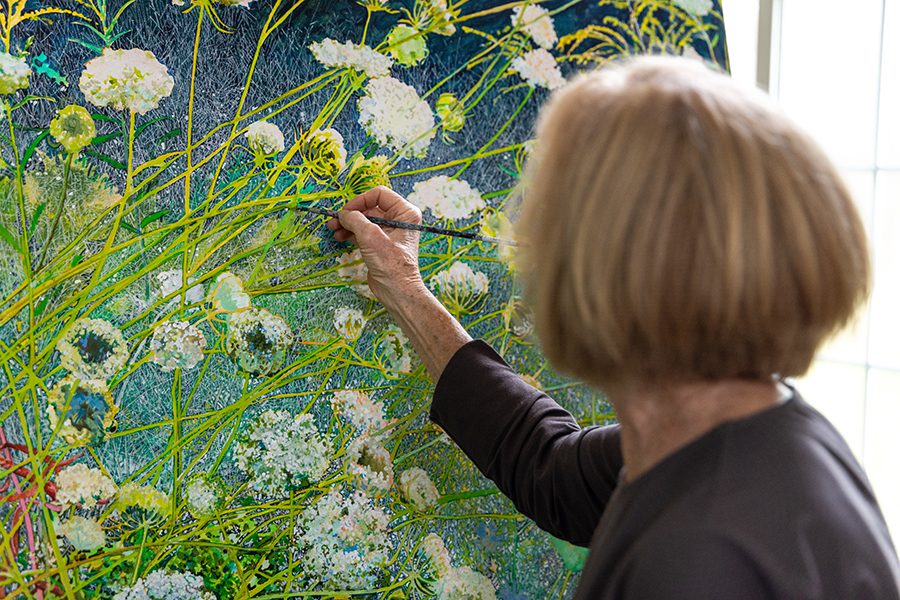
Artist Elizabeth Bradford in her studio. Photographed by Peter Taylor in Charlotte, NC, November 19, 2024
Bradford spoke with SouthPark Magazine about her process, inspiration and being bold in her artwork.
Comments have been edited for length and clarity.
Your work is in several museums and corporate collections. Was that always a goal or just something that came about as you continued to paint?
Surely that’s a goal, to get it out into the world and to have affirmation from art historians, curators, and other artists. It’s helpful and instructive too. You learn from it. Sometimes it encourages you to be braver.
Obviously, your work is inspired by nature. How do you go about interacting with nature?
I used to just observe, but then I got engaged in backpacking. I’ve always loved camping, but I hadn’t been into ultralight backpacking so I wanted to do that in my 60s. I was just talking about it with some friends, how much I really wanted to learn how to do that. There were these two buddies of mine who said, “We do that once a month. Do you want to go with us?” So I did, and they are great naturalists and hardened campers. They know their way around the woods. They let me go with them and were patient with me and taught me so many things about how to survive in the wilderness.
And how did that lead to the art?
I’d been painting my normal environment, which was the [family farm], small town, nature around me, but once I got [out in the wilderness] it was so extravagant. The things I was seeing were so different from ordinary inhabited environment. Trees are allowed to grow there until they fall over. There are enormous trees and all kinds of lichen, mushrooms and wild orchids.
One of my camping buddies is a biologist, so he was always pointing out all these things I might have otherwise missed. He’s actually a stream specialist, which has been fun, too, to study the nature of streams. It’s just a fun deep dive to not only sleep on the Earth, but to be taught about it.
What are your favorite places to get inspiration?
We’ve been going a lot up to Wilson Creek [in Caldwell County]. It’s part of a giant park that draws trout fishermen, hunters and backpackers. There’s a huge gorge. It’s like North Carolina’s Grand Canyon. A lot of people from that area go there to spend a summer day. And there are a lot of wilderness areas — we found some places there that nobody goes much, off the beaten track.
They took me to Grayson Highlands [State Park in Virginia], but we also camped on Cumberland Island [in coastal Georgia]. We like to go to Goose Creek State Park, which is just off the Pamlico Sound. We take kayaks there. That’s super inspiring — I write about it, but I also paint it.
Some of my first more experimental landscapes were inspired after that first trip to Cumberland Island. Initially, my landscapes were couched in natural colors with a limited palette. After Cumberland, I started experimenting with extravagant color that was not drawn directly from nature. It was just so exotic that it called for something like that.
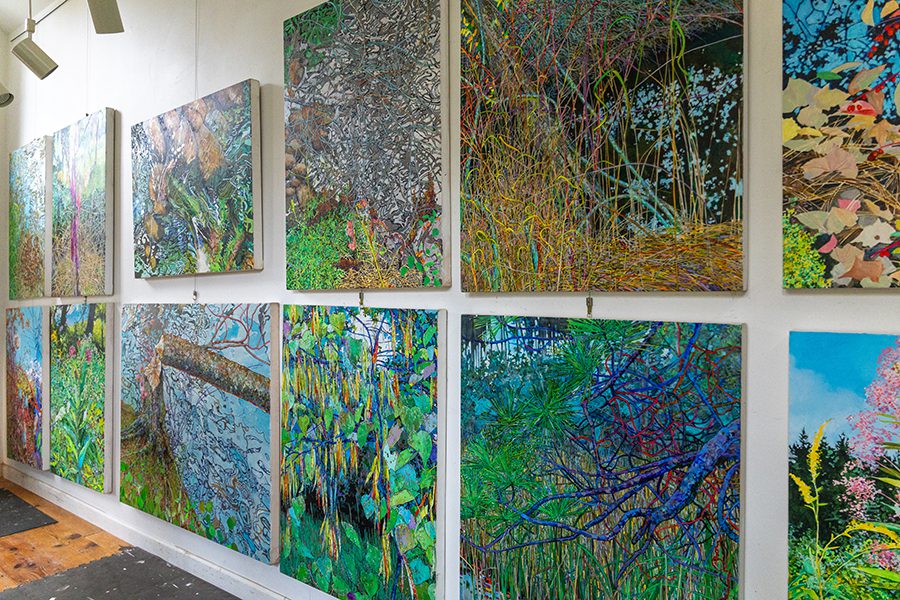
Artist Elizabeth Bradford’s studio. Photographed by Peter Taylor in Charlotte, NC, November 19, 2024
What is your process once you’ve decided to paint a subject?
Sometimes, I’ll do some pencil drawings to establish the composition. A lot of times, the paintings may revolve around something as simple as one tree — that’s sort of like a rectangle, so it becomes really tricky to make that rectangle interesting. I might move the lines of that tree trunk around 10 times with a pencil before I come to what I think is going to be engaging.
I’ll set up the basic bones of the construction of a piece with a pencil. Not always, but often. And then, a lot of times, I’ll start with the thing that is the most obvious in the foreground. Most people paint a background and then paint on top of it. I paint from the foreground back. I start with what’s immediately in front of me, and I paint it first. Then I paint the world around that.
That’s interesting because that’s the opposite process of watercolor, right? But you’re working in acrylics, so you can do that.
Watercolor led me there, because I used to paint for many years in gouache, which is opaque watercolor — you paint the color that you lay on top of another. There’s a certain level of color pollution that goes on. You can use that to your advantage, or it can really wreck what you’re trying to do and I’m striving for a real clarity of color. My colors aren’t muddy — they’re pretty clear. When I was doing gouache, it didn’t work for me to lay color on top of color, so I started with everything sort of being separated out.
When I moved to acrylic painting, I just carried on that same procedure, and [it’s unique] because of the color quality and quality of brush stroke. It also causes me to think about all those spaces in between the branches as shapes. I’m painting each of those shapes as if they were a subject themselves. It’s sort of a geometric way of breaking down a scene. It’s “geometricizing” the negative space. I’m real red hot about the negative space and how to shape it. Often, it’s the most interesting thing about a picture.
If you’re drawing a tree and all these intersecting limbs, it ends up being a thousand triangles, which is fun. That’s something cubists taught us: to deconstruct things into their basic geometry.

Did anyone or anything influence your current style?
I spent an awful lot of time studying the impressionists and post-impressionists with deep interest. Early on, I was really fascinated by Georgia O’Keeffe, who is a great pioneer of taking the natural world and rendering it abstract. Of course, I was especially fascinated by her because she’s a woman, and there weren’t many of them to look to as role models. So, she was a feminist touchstone.
Your work is vibrant and large-scale. How do you choose your palette for each painting, and how do you determine the size?
I like scale because it’s unusual in my life. Women are conditioned, particularly of my generation, to be quiet and not take up space. One of my avowed goals is to take up space. To speak through the work with some boldness.
The palette … sometimes in nature I see things trend toward a color, so I just use that color. So, a gray that trends toward violet, I just use violet. I push things to extremes of what I perceive. And I like really pure hues. I like the clarity of color. I think that comes out of exposure to pop art and 20th- and 21st-century life.

Artist Elizabeth Bradford in her studio. Photographed by Peter Taylor in Charlotte, NC, November 19, 2024
How did you choose the paintings for this exhibit?
The paintings in this exhibit are the most recent things I’ve done. And it just happened to be a difficult time for me, so the work has some edges to it that are speaking about that. I didn’t realize it at the time I was doing them but now, in retrospect, I realize I was channeling those anxieties and those triumphs.
What do you hope that this exhibit at Davidson College, essentially in your backyard, will achieve that others may have not?
It is different for me, showing at Davidson, because this town and this school have supported me as an artist since I was in my 20s. People all over this town own my early work. They’ve just shown up, time after time, for the many exhibitions I’ve had in the area. Davidson has played a large role in my life just because it educates everybody in its sphere. I’ve always benefited from its intellectual generosity.
My hope for this show is that on a cold February night, it brings a sense of joy, community and hopefulness. I always hope that my work inspires people to look at the natural world with greater reverence.
**
Warp Weft Water Weeds is on view at the Van Every/Smith Galleries at Davidson College from Feb. 13-April 9. An opening reception will be held Feb. 13 from 5:30-7:30 p.m.
**
Jay Ahuja has lived, worked and played in Charlotte since 1986. He has one wife, two stepsons and one dog. He’s had two sports travel guidebooks published and produced a documentary film, “Live From The Double Door Inn.” He serves on the Charlotte advisory Board of North Carolina Outward Bound School and retired from WDAV 89.9FM, the region’s classical public radio station.
Featured image: Detail of Twenty-three Stream Crossings, Green, 2024, 36 x 48 in. acrylic on canvas with broken glass, courtesy of the artist, photograph by Brian Quinby