


by Michael J. Solender
Though 16th- and 17th-century Baroque realist Michelangelo Merisi never had Instagram, TikTok or Facebook, he remains one of the world’s greatest cultural and artistic influencers more than four centuries after his death.
Widely known as Caravaggio, the controversial artist’s approach has reverberated across centuries. His bold chiaroscuro (strong contrast between light and dark), intimate compositions and unvarnished, street-worn figures have influenced artists from Rembrandt and Matthias Stom to contemporary filmmakers such as Martin Scorsese and Isaac Julien, as well as music videos from R.E.M. to Johnny Cash.
Charlotte audiences will have the opportunity to view a rare masterwork by the Italian painter at The Mint Museum, when Caravaggio | Revolution opens April 26. The exhibition consists of holdings on loan from Italy’s Fondazione Roberto Longhi.
Longhi, a late Italian art historian, scholar and curator, played a pivotal role in shaping modern understanding of early Renaissance and Baroque painting. His influential writings and critiques helped elevate Baroque masters, most notably Caravaggio. Longhi’s collection is central to the holdings at his foundation in Florence.
Alongside Caravaggio’s complex and homoerotic “Boy Bitten by a Lizard” (c. 1597), the show features more than 30 paintings by leading Baroque masters and Caravaggisti, artists who internalized and reinterpreted Caravaggio’s groundbreaking aesthetic. The show includes works by Jusepe de Ribera of Spain, Dutch master Stom and Valentin de Boulogne of France.
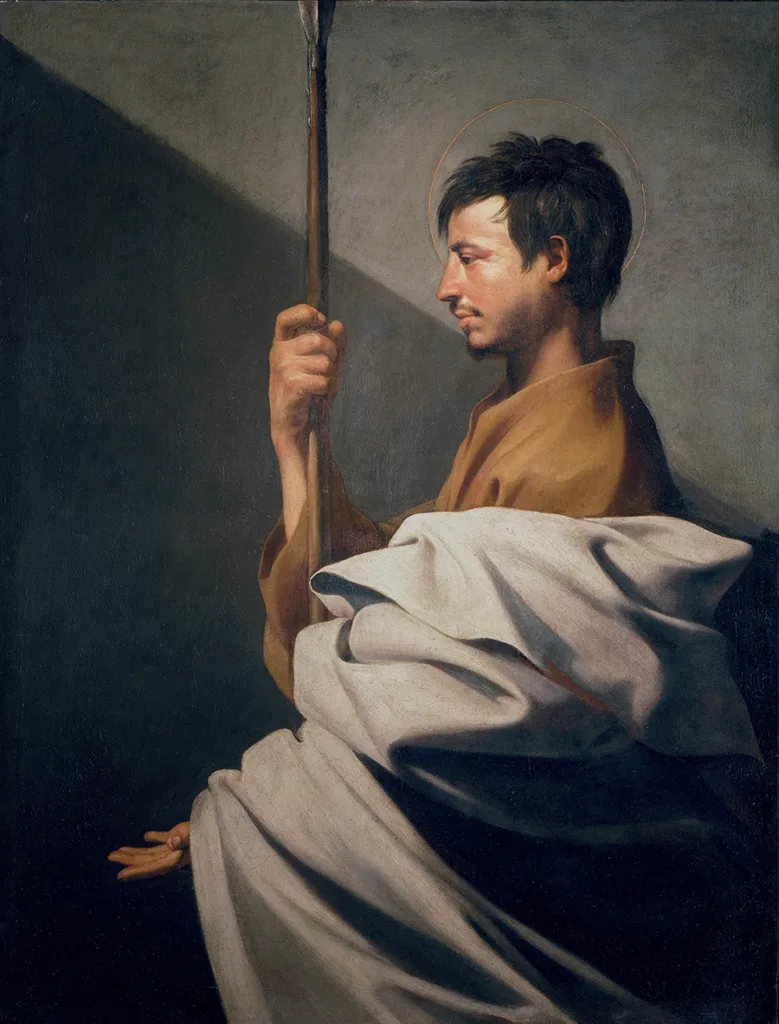
Jusepe de Ribera (Spanish, 1591–1652). St. Thomas, circa 1612, oil on canvas. Florence, Fondazione di Studi di Storia dell’Arte Roberto Longhi.
Caravaggio’s style: Four defining elements
Caravaggio’s style can be distilled into four defining elements, according to Mint Museum President and CEO Todd Herman.
“First is his radical use of light and dark,” Herman says. “Figures emerge sharply from deep shadow, creating drama, focus and psychological intensity. This chiaroscuro heightens emotion and pulls the viewer directly into the scene.”
Caravaggio’s uncompromising naturalism is the second element, Herman notes. “He painted real people with visible flaws — dirty feet, worn faces, imperfect bodies. For religious works, this made sacred stories feel immediate and human rather than distant and idealized.”
Bold composition also characterizes Caravaggio’s style, according to Herman. “He placed figures close to the viewer, used unexpected viewpoints, and reimagined familiar subjects without relying on traditional models, using beggars, prostitutes and even himself in his work.”
Finally, Caravaggio appears to have worked directly on canvas, without preparatory drawings. Influenced by Venetian painters, this method contributed to the immediacy and raw power that defined his work and distinguished him from his contemporaries.
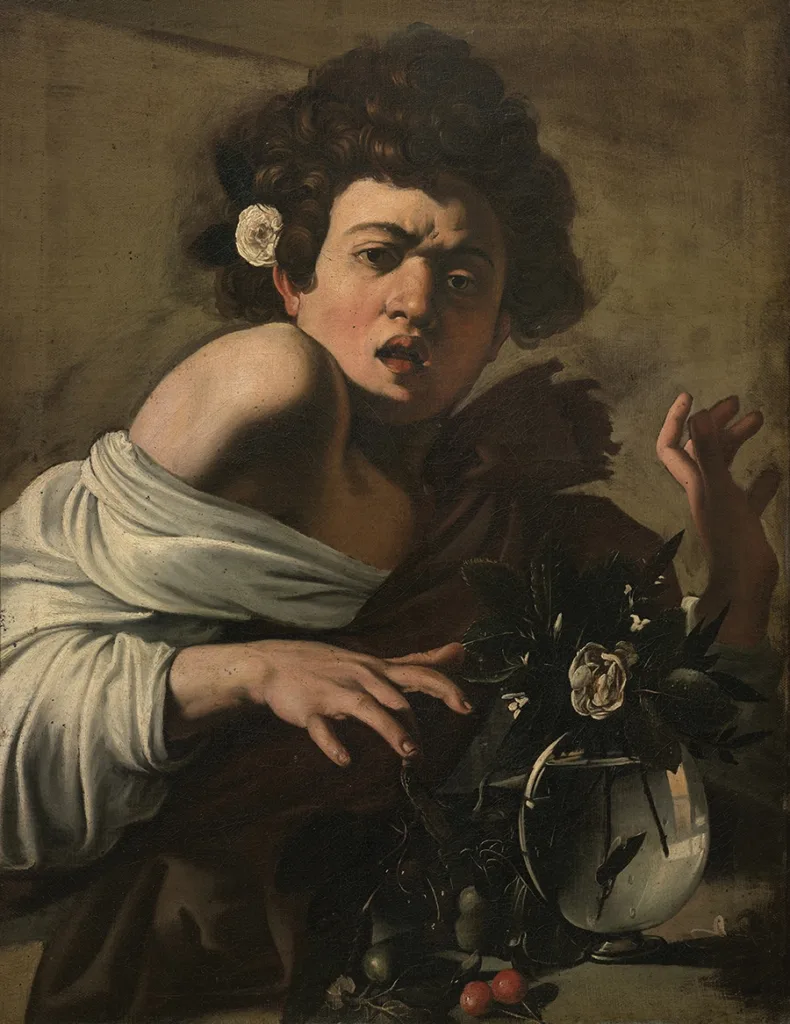
Michelangelo Merisi, known as Caravaggio (Italian, 1571–1610). Boy Bitten by a Lizard, circa 1597, oil on canvas. Florence, Fondazione di Studi di Storia dell’Arte Roberto Longhi.
Radical influence
Beyond the striking intensity of his paintings, Caravaggio’s life was just as dramatic. He was known for his quick temper and involvement in street fights, and he faced a murder charge that forced him to flee Rome. Stories about his relationships have also added to his intrigue. He died at just 38, and the exact details of his death remain uncertain.
For Herman, the fusion of radical artistic influence and a biography that still feels urgent and contemporary made bringing the exhibition here impossible to resist.
“I’m fascinated by the dramatic aspects of his background and how he was viewed then in contrast to how he’d be viewed today,” Herman says. “Do time and context allow for grace where we wouldn’t necessarily give it today? These are fascinating discussion points for museumgoers to explore.”
“Boy Bitten by a Lizard” is one of two nearly identical works of the same era by Caravaggio; the other is on display at The National Gallery in London. The work features an effete young boy with a flower tucked behind his ear. The figure is cited by some scholars as Bacchus, the Roman version of the Greek god, Dionysus. Some see this as a nod to freedom from social norms.
The boy is clad in an off-shoulder white drape and surrounded by grapes and other luscious fruits. Upon close inspection, he is being bitten by a small lizard piercing the middle finger of his right hand.
Whether or not this is an allegorical painting depicting the pain associated with excess — wine, sex, indulgence — or simply an emotional study of a boy caught by surprise is left to the viewer.
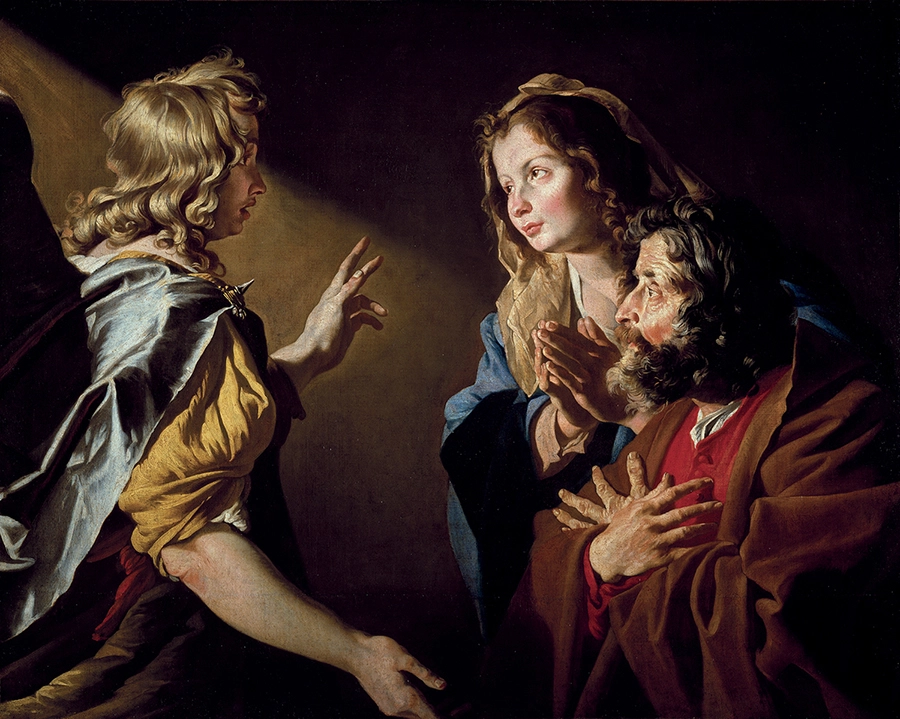
Matthias Stom or Stomer (Dutch, possibly Flemish, 1600–50). Annunciation of Samson’s Birth, circa 1630–32, oil on canvas. Florence, Fondazione di Studi di Storia dell’Arte Roberto Longhi.
Atmosphere of mystery
Caravaggio’s stylistic influence continues with many filmmakers and contemporary artists today, Herman notes, when asked about the exhibition’s title, Revolution.
“When filmmakers like Martin Scorsese openly credit Caravaggio, saying [the feature film] Mean Streets draws directly from his work, it underscores that Caravaggio’s influence goes beyond dramatic lighting to creating an atmosphere of mystery where action is revealed but never fully explained. [It’s a] cinematic approach that continues to shape photographers, videographers and filmmakers.” SP
WANT TO GO? Caravaggio | Revolution: Baroque Masterpieces from the Roberto Longhi Foundation runs April 26 – Oct. 25 at Mint Museum Uptown. Tickets are $10 plus regular museum admission.