


by Olivia Lee | photographs by Peter Taylor
It’s Friday night, and my husband and I arrive at Stagioni, as we do almost every week. As we enter, he grabs the antique brass doorknob to open the aged wooden door, the kind that closes and doesn’t quite fit into the frame. Stagioni is dark and intimate, dimly lit by low-hanging red lights reminiscent of old Georgian-era jewels.
The hostess greets us with a warm smile and leads us to the cozy six-seat bar. Without hesitation, the bartender begins to pour a glass of Velenosi — a Montepulciano and Sangiovese blend — for my husband and a coupe of Terre Gaie prosecco for me. “Hi, how are you?” she asks, as she turns to order us meatballs. She knows the succession of our meal. She knows the pace of each course. And she knows that we like to linger in the corner of the bar, talking for several hours.
The meatballs arrive in a black stone bowl — slow-simmered ground pork coated in house-made marinara, sprinkled with grated Parmesan cheese and served with a crusty ciabatta for soaking up the sauce. I take a sip of the prosecco, and take a deep breath. In that moment, comfort is the only thing that I feel. And, as a nurse practitioner, for the first time that week I feel like I’m the one being taken care of.
As we eat our meal, Brittany Cochran, Stagioni’s executive chef, stands quietly in the shadows, her arms folded as she observes the dining room. Her eyes scan the tables as she listens to the laughter of guests, waiting for the joyful silence that inevitably occurs when the food arrives and the first bites are taken.
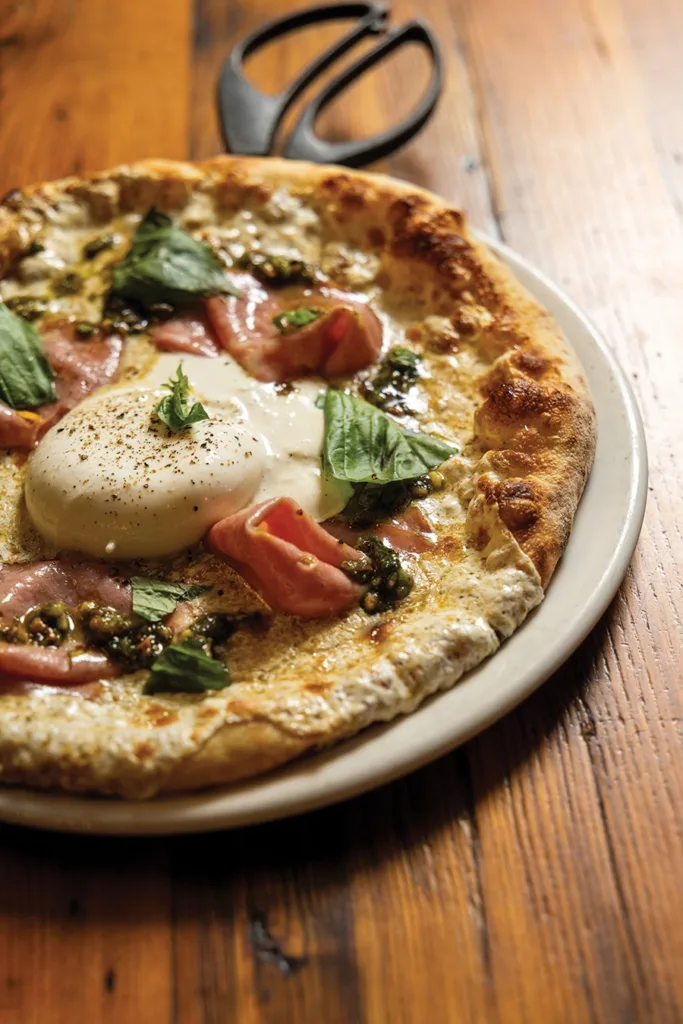
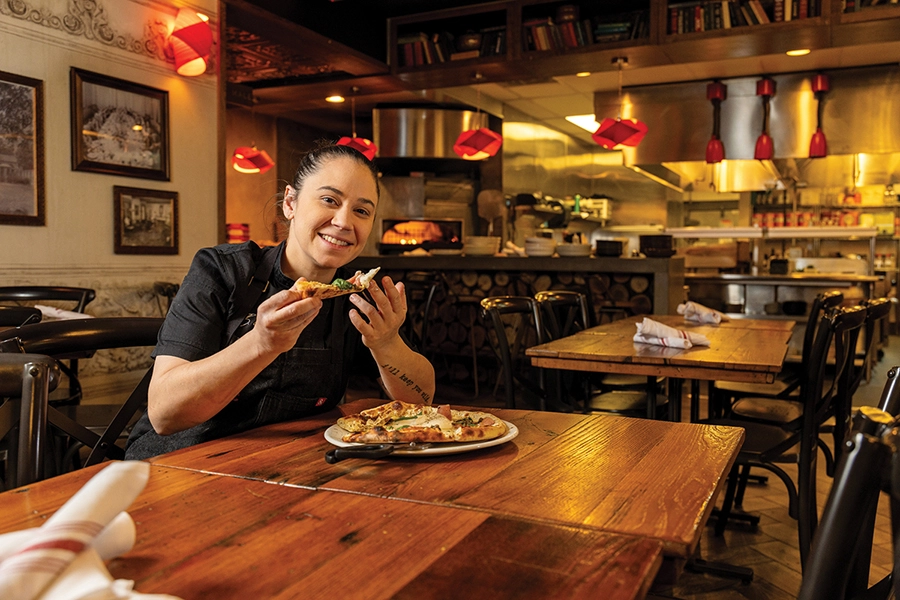
Mortadella pizza at Stagioni
AN EARLY LOVE FOR FOOD
During grade school, Cochran spent summers at her grandparents’ house in Columbus, Ohio, helping plant crops in their garden and tending to them until it was time to harvest and either can or use for cooking. Being a part of the agricultural process from start to finish is where her love for food began.
Cochran studied culinary arts and hospitality management at Charlotte’s Johnson & Wales University, before venturing off to New York with a friend.
“We had no job, no apartment, probably a couple hundred bucks in our pocket, a U-Haul full of college furniture and ended up finding a great place in Crown Heights, Brooklyn,” recalls Cochran. Three days later, she walked into Forgione, Mark Forgione’s Michelin-starred New American restaurant in Tribeca, and introduced herself to the sous chef. She started as a line cook two days later and worked there for the next three and a half years.
“It was no joke,” Cochran says. “It was an intense restaurant, and it was a very busy restaurant.” After Forgione, she worked for 10 months at Marea, a white-tablecloth, coastal Italian restaurant with two Michelin stars and a brigade-style kitchen that was humbling to a young chef, Cochran says. “You run out of something, they kick you off the line and you have to walk with your tail between your legs, and then you kind of get demoted and then you have to start back over again.”
Missing the connections with customers she had experienced at Forgione, Cochran decided it was time to return to Charlotte. Working at Mimosa Grill in uptown, she learned the business side of the industry: inventory, scheduling, event planning and catering.
Shortly after the onset of the pandemic, Cochran remembers being on her hands and knees, scrubbing the restaurant’s baseboards, preparing for guests to return. That’s when she received a text from Bruce Moffett, the owner of Moffett Restaurant Group, about another job opportunity. In July 2020, Cochran was hired as executive chef at Moffett’s seasonal Italian restaurant, Stagioni, Four Seasons of Food.
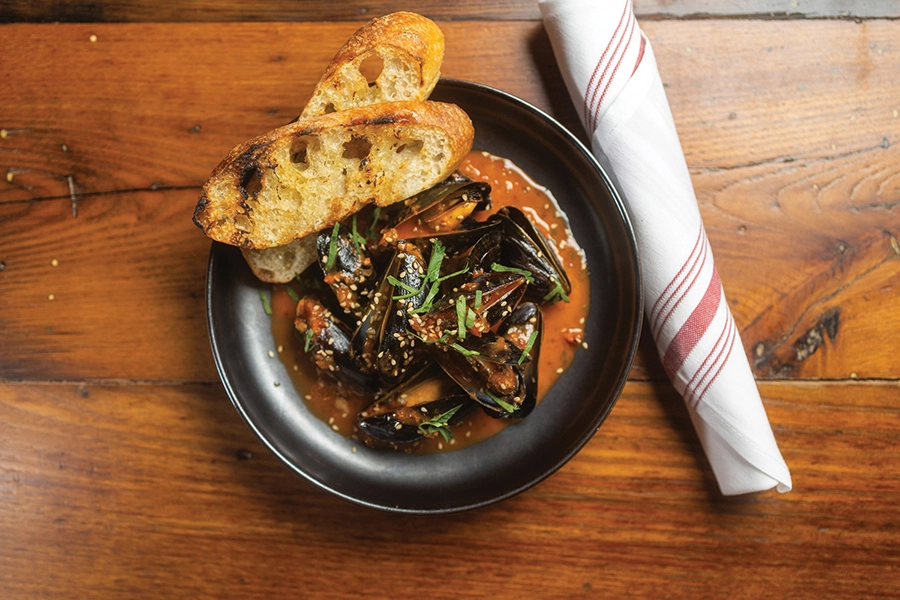
PEI mussels at Stagioni
A CHANGE FOR THE BETTER
Cochran, who develops the menu and manages the kitchen at Stagioni, joined a seasoned staff who had worked together for several years.
“And during Covid, nobody knows what’s going on. So having that stress of being the new guy, the top guy, understaffed during Covid, nervous about presenting menu ideas to my chef owner, it was intimidating.” After slowly making a few modifications, Cochran noticed that one by one, her staff started leaving. She reached out to her mentor Mark Forgione, who reminded her of the unprecedented nature of the time.
“‘Don’t walk away. Keep your head down and cook your food,’” he told Cochran. It was the confidence boost she needed as she showed Moffett her capabilities. But still, something was off, so she started going to therapy.
“I have changed drastically since I first started [at Stagioni]. I came in very hard. I came in very rough, not fun to work with, I’ll be honest. And that took a lot for me to accept and recognize,” Cochran says. “But I’ve made changes, because with that behavior — being too hard, being too New York — it pushed staff away … And I don’t blame them.”
Cochran wanted to create an environment that fostered empowerment, where her staff felt supported to overcome obstacles while still learning, growing and perfecting their craft. She adjusted her communication style and realized she could be direct without being degrading.
One day, during a busy service in the middle of the summer, she found her sauce cook in the walk-in freezer, stressed and overwhelmed.
“I don’t know where I’m at,” he told Cochran. “The tickets you’re asking for, I don’t have.” In the past, Cochran might have responded with frustration. Instead, she listened attentively and offered him reassurance. Ultimately, the two walked out of the freezer and finished service working side-by-side.
For Cochran, therapy was not only a gift to herself but to her staff, many of whom have been with her for several years now.
“I’m very honored, and I’m really proud of that,” she says. “I want to be their Mark [Forgione]. I want to be their mentor, so when they decide to move on, they can come back and lean on me, and be proud to say that they worked for me because that’s how much Mark means to me. I would love to carry that on.”
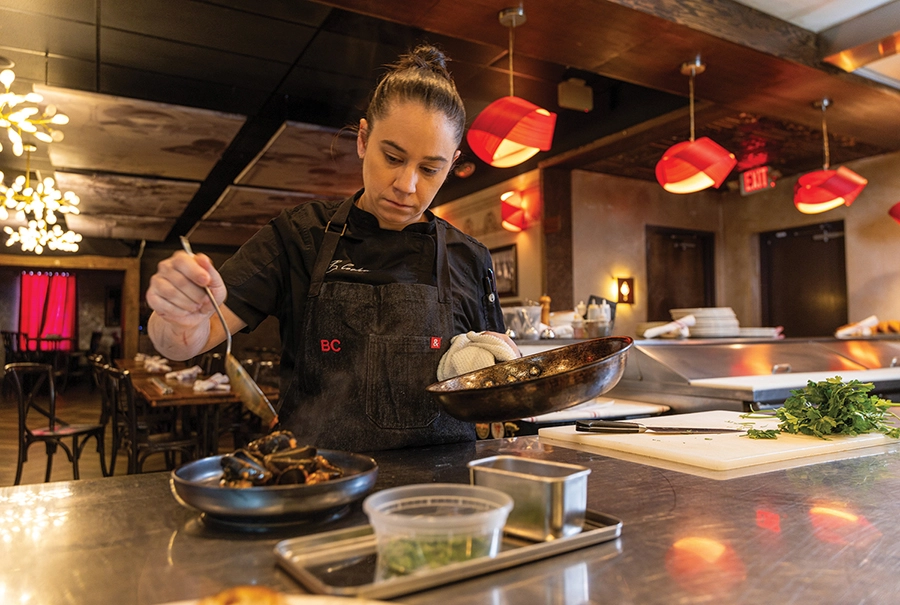
GRACE UNDER PRESSURE
Stagioni draws inspiration from its name, which means “seasons” in Italian. The menu changes regularly and is influenced by ingredients grown by local farmers.
“I like to take flavors that are recognizable and kind of turn it into something [a little different],” Cochran says. “For example, everybody knows vodka sauce. Everybody knows spicy vodka sauce. But we did a smoked, spicy vodka sauce because it pulls in a little bit of Southern. [Since we’re in the South], it’s still recognizable. It’s not too weird — it’s tasty, it’s simple, it’s well done.”
A guest favorite is the mortadella pizza, which was inspired by a dish Cochran had on a trip to Brighton, England. Cochran’s version is made with pistachio cream; topped with mozzarella, mortadella, pistachio pesto and basil; finished with a large ball of burrata; and drizzled with hot honey.
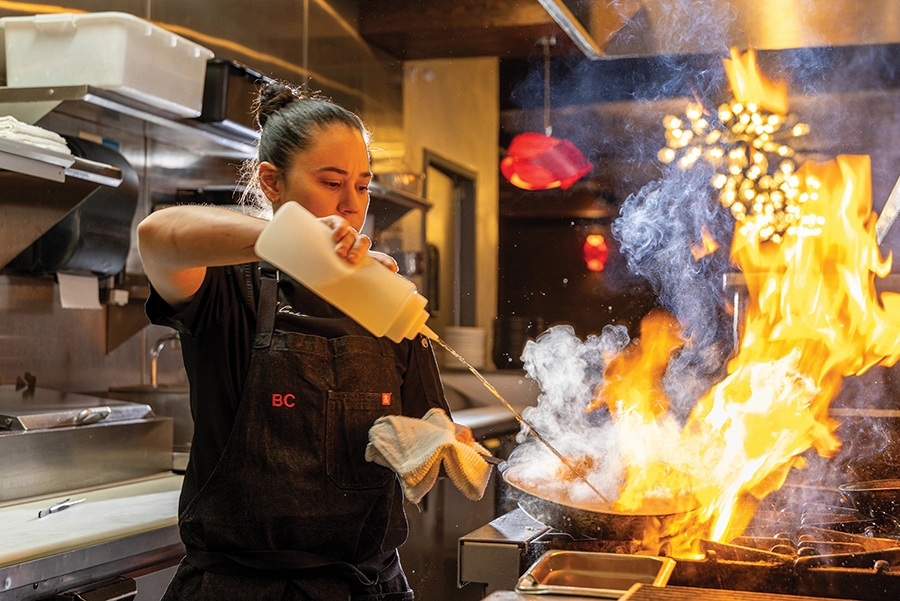
In the kitchen, Cochran says she thrives under pressure, which allows her to keep her cool while directing her staff of seven. She knows at what times during service that the pace will pick up, requiring everyone to execute with precision and expedition.
“We can tell the way the dining room sits, the way the tickets come in, but it’s my job to be like, ‘OK, listen to my pace. Don’t worry about the ticket machine that has not stopped for an hour. Just listen to my call and we’ll get through this.’ And then once we do and we can all kind of breathe, I’m like ‘Get ready. It’s going to come again at 8 o’clock.’”
Cochran loves the hustle and bustle, the loud voices, the sound of the sauté pans slamming against the burners and the noise of the dishwasher rumbling. But above all, she loves the laughter of the dining room. Stagioni’s open-kitchen design gives her a front-row seat to witness and interact with diners.
“One thing that is probably my favorite … [guests will be] laughing, they’re having a great time. And then when food hits, it goes silent. And I think that’s awesome. That means that they are just enjoying.”
This spring, guests might recognize Cochran outside of the kitchen at Stagioni as one of the participants on Season 23 of the Bravo competition series “Top Chef.” She couldn’t share much about her experience filming, but she admits it was one of the hardest things she has ever done.
At times, she worried about her performance and wondered whether she deserved to be on the show. After speaking with her therapist, she was reminded how fortunate she was for the opportunity. And while the experience was challenging, she learned about other cuisines and developed special friendships with other participating chefs.
“I can honestly say that being selected for ‘Top Chef’ … getting to represent my home city of Charlotte … is the greatest honor of my career. To join this amazingly talented group of chefs is a professional highlight. I feel like I have upped my game to a truly national playing field, and I am beyond grateful.”
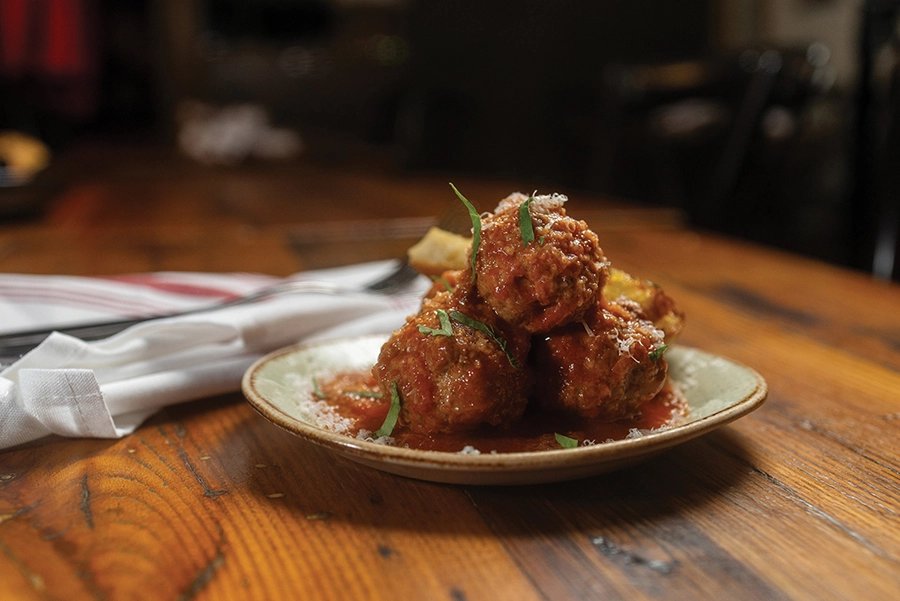
Meatball appetizer at Stagioni
KEEP THEM COMING BACK
Back at Stagioni, the bartender clears our appetizer plates and another glass of wine is automatically poured.
“Are you going to get your usual or are you going to mix it up?” she asks. “Our usual,” my husband excitedly replies.
While the Spicy Vodka Radiatori is no longer on the menu, Cochran still makes it for us. It’s become something we look forward to each week. As we talk for this story, Cochran tells me that the kitchen made a large batch of vodka sauce before the dish was retired. “We freeze it in portion cups, so that when you guys come, we’ll pull it,” she says. “[When the ticket comes in,] we know Ryan and Olivia are here.”
For the first time during our almost two-hour interview, I don’t know what to say; I am taken aback by this act of kindness. “Oh my goodness, thank you so much,” I manage to reply, though my response doesn’t fully capture the appreciation that I feel for her hospitality.
Stagioni is a neighborhood spot with lots of regulars. Cochran wants to stay true to the dishes that keep guests coming back, like the pizzas and PEI mussels steeped in a white-wine broth with crushed tomatoes and pepperoni. But she’s also ready to begin branching out and pushing boundaries, both on and off the plate.
“It’s not rare that females are in the culinary industry anymore, they are running restaurants and leading kitchens.” And without a doubt, Cochran is one of Charlotte’s rising culinary stars. SP
Women who lead: This is the first installment in a four-part series featuring trailblazing women in Charlotte’s culinary scene. From chefs to bakers, mixologists to food-truck owners, local talents talk passion, perseverance and navigating their industries with grit and grace.