


by Ayn-Monique Klahre | photographs by Richard Israel
At the edge of the woods, the troll peeks out: a baby by the standards of her kind, but at over 12 feet tall, she’s a giant to most of us humans. In one hand, she’s holding onto her mother’s tail, which winds deep into the trees — all the way to the hidden spot where Mom sleeps with one eye open, attentive to her children. This baby troll’s siblings have gone further afield to play, and their father is foraging nearby.
These trolls are not alive, of course, but a multifigure sculpture called The Grandmother Tree from Danish artist Thomas Dambo. There are five of these trolls in Raleigh’s Dorothea Dix Park, one in the Southwest Mill District of High Point and another in Crescent Communities’ River District in Charlotte. Taken together, The Grandmother Tree is the largest permanent installation of Dambo’s trolls in the United States.
The idea to bring the trolls to North Carolina came when Dix Park Conservancy Art Task Force chair Marjorie Hodges and her husband, Carlton Midyette, visited the Coastal Maine Botanical Gardens in Boothbay, Maine. There, they came across a Dambo troll installation called Guardians of the Seeds.
“We saw the trolls and it took us 30 seconds to say, we need these for the park,” says Midyette. He worked with philanthropist Tom Gipson to lead a campaign to finance a project of that scale for Raleigh.
In Charlotte, developer Crescent Communities saw its troll, named Pete with the Big Feet, as a natural extension for its vision of the River District, a new 1,200-acre master-planned community in west Charlotte.
“Big Pete is more than just a striking public art piece,” says Rainer Ficken, senior managing director of the River District. “He’s an invitation for Charlotte and its visitors to engage with the land in a new way, to explore our public trails and to reflect on the impact each of us has on the environment.”
Part of what attracted Dambo to this project was the way his installations would be part of reinventing and reengaging with urban spaces. The 308-acre Dix Park, for example, was a longtime site of a state psychiatric hospital.
“It’s a land of reinvention and restoration,” says Kate Pearce, executive director of Dix Park for the City of Raleigh.
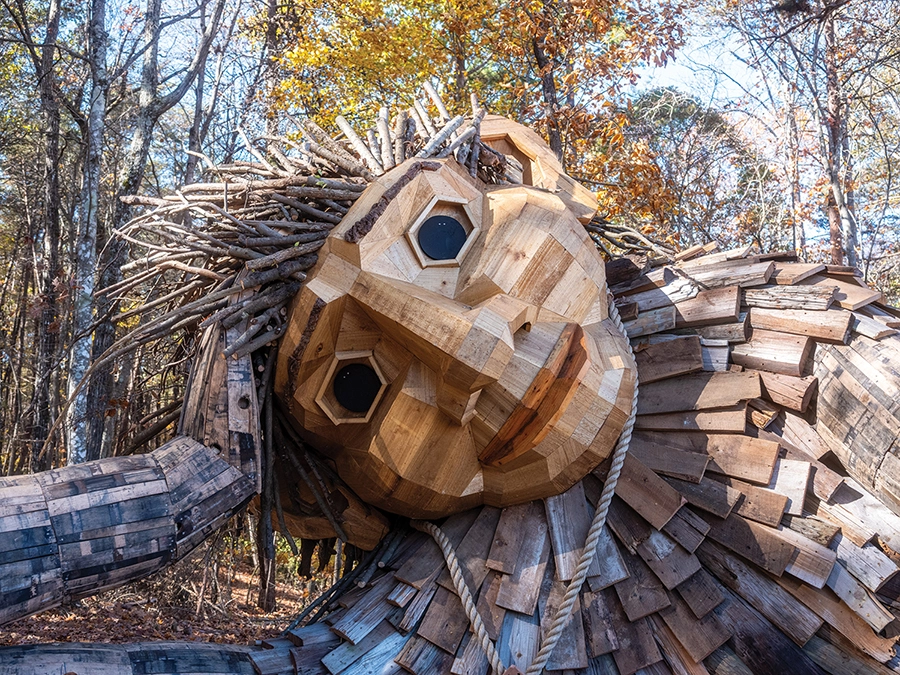
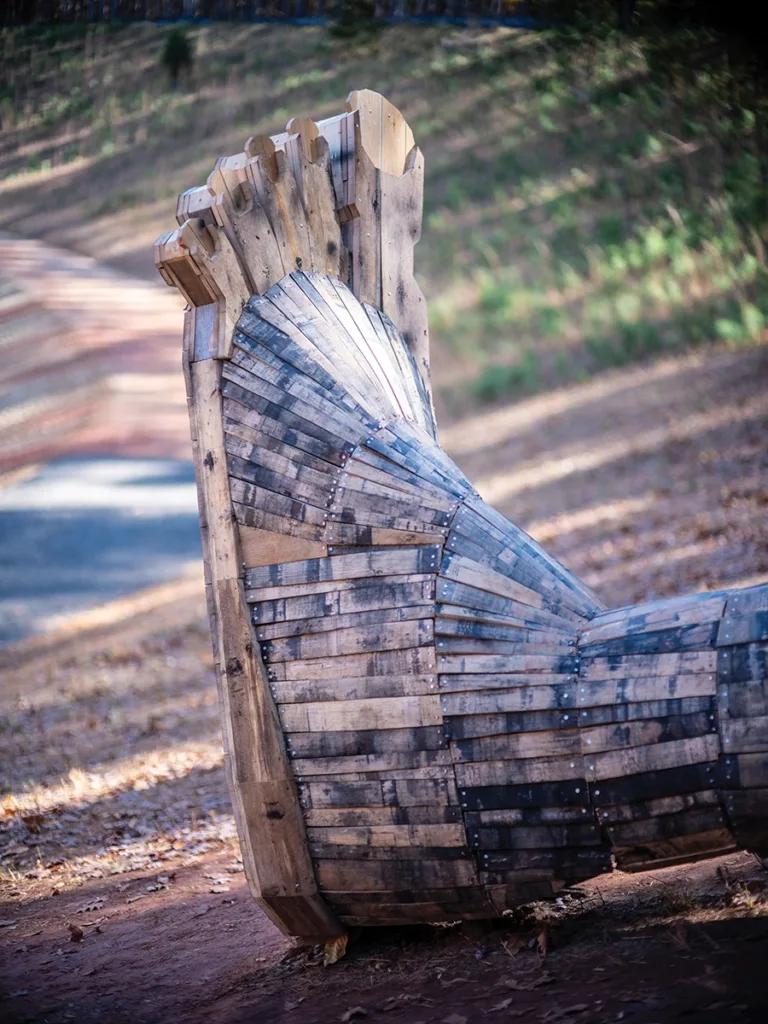
The sculpture’s foot is 10 feet tall
For each of his installations, Dambo crafts a narrative around the trolls that offers a sustainability lesson and a little mystery, too. In his telling, the North Carolina trolls are all protecting the Grandmother Tree, the oldest and wisest tree in the forest, who is hidden in another forest in the area, disguised as a regular tree. Pete, the Charlotte sculpture, is a teenager who has ventured away from home; he’s lying near a pond in the woods bordering Airline Bike Park. The sculpture is 65 feet long.
Each of the seven trolls wears a medallion around its neck that contains pieces of the same heritage tree. Taken together, they share the location of the Grandmother Tree. (We’ve been told it’s in Raleigh, but that’s as much of a hint as we got.) The medallions were made by Billy Keck and Melody Ray of Raleigh Reclaimed, a company that makes furniture using salvaged woods.
In part of the poem that tells this story, Dambo says:
But one species, all trolls, has learned to fear through evolution
Invasive, a pollution, you must never trust a human
A human seeks the oldest trees, to kill and cut them down
and chop it up in tiny pieces, haul it, burn it in their town
And so the trolls have cast a spell, enchanted the grandmother tree
So no human can find her; now she looks like any other tree
But every time the moon is dark, the red wolves howl and bark
This is the sign that sparks the start, the trolls to search the park
Each of the trolls came together through a robust community effort. Dambo and his team of professional troll-makers designed the creatures and built the frames, then used local volunteers to build the trolls on-site. In Charlotte, Crescent Communities solicited volunteers from their own staff, as well as nonprofit partners including Daniel Stowe Conservancy, Catawba Lands Conservancy, Sustain Charlotte and the Tarheel Trailblazers.
Dambo’s team also worked with local organizations to source the reclaimed materials to build the trolls. Crescent Communities used its own construction waste, as well as recycled material donations from D.H. Griffin and She Built This City. In Raleigh, Habitat Wake and its ReStores donated much of the material, as did Raleigh Reclaimed, which sourced rot-resistant woods like cedar, oak and locust for the project.
“We use materials that otherwise would go into landfills or the waste stream, so we had a built-in process for collecting these materials,” says Ray. “It just made sense to partner on the project.” Additionally, Kentucky Bourbon Barrel chipped in 17 tons of old bourbon barrels (most of which went into making Raleigh’s mama troll’s 620-foot tail), and Midyette donated the remains of a fallen-down barn and about a mile of old fencing he had on his property.
The goal with The Grandmother Tree is to draw visitors to these natural areas — and for these visitors to experience the same sense of magic and wonder as Dambo did going into the forest as a child, he says.
“It’s about bringing magic back into spaces,” says Pearce. SP
PAY A VISIT TO PETE: Charlotte’s troll is located in the Westrow mixed-use town center at the River District, bordering Airline Bike Park. Visit trollmap.com for more information on the artist and troll locations.
Featured image: Pete with the Big Feet is a 65-foot-long sculpture in the River District