


Charlotte food entrepreneurs serve up authentic, artisan fare — and customers are lining up.
by Olivia Lee
It’s a chilly Friday in February 2023, and gray clouds cast shadows over a quiet suburban cul-de-sac in Old Foxcroft. Nestled among a scattering of ancient trees is a white ranch home with a small enclosed carport jutting out from one side. Cars line the street and take turns shimmying in and out of the driveway. A line forms near the Dutch door of the carport as customers patiently wait to pick up bread from the cottage bakery at the Rose family home.
Douglas Rose, wearing an oversized sweatshirt dusted in flour, greets buyers with a smile. Standing behind him, near a large box filled with bread, is a small boy — one of his four children — who eagerly helps his father hand out orders.
When it’s my turn, Rose hands me two brown bags, each filled with a half-dozen just-baked bagels. As I make my way back to the car — the smell of the garlic, onion and poppyseed seasoning escaping from the crinkled top of the warm bag — I hear him warmly acknowledging the next customer and striking up a conversation.
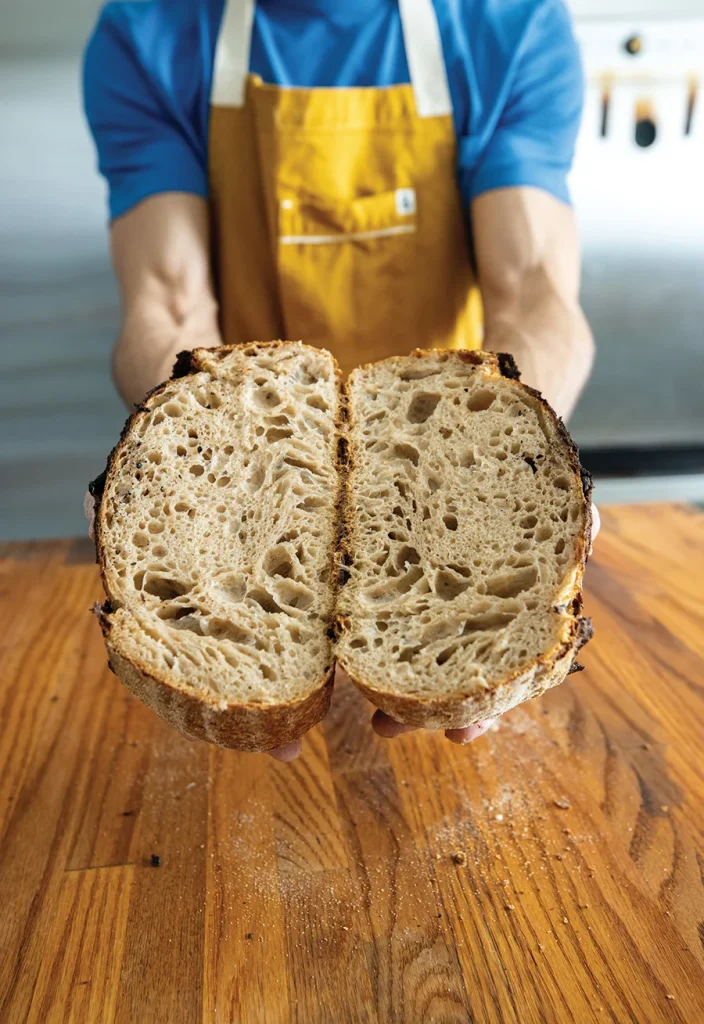
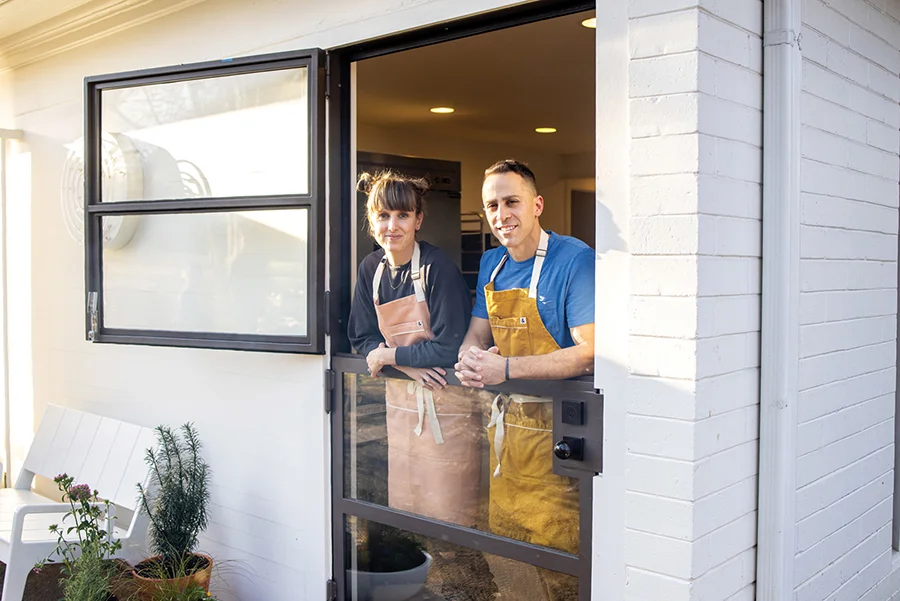
Team Rose Bread, started in 2020 by Douglas and Kaitlin Rose, makes 100% sourdough bread with organic flour from suppliers like Linley Mills in Durham and Anson Mills in South Carolina. Photographs by Peter Taylor.
Home-made
Many relationships were forged at the Dutch door of that bakery, known to the community as Team Rose Bread.
“Those interactions were super life-giving,” says Rose, who started the bakery with his wife, Kaitlin in 2020. “People would want to linger and talk and share their life story. We walked through lots of seasons with people who were strangers to us but became friends as a result of this business.”
The Food Freedom Act, which allows for the production and sale of food products made in a home kitchen, enabled Rose and his wife to start this new venture. After their leather-goods business was put on ice during the pandemic, the duo converted their 200-square-foot carport into a bread shop.
“Starting the business [as a home food processor] was faster than brick-and-mortar, which takes way more capital, way more time and has way more moving parts. What we were able to do in a short period of time, we would never be able to do in the brick-and-mortar world,” Rose says.
Food entrepreneurs like Team Rose Bread are a part of a growing cottage-food industry that focuses on responsible sourcing and mindful consumption. While many states have cottage food laws, North Carolina does not. Instead, the state Department of Agriculture’s Food and Drug Protection division provides guidelines, with a few limitations.
In North Carolina, regulations prohibit the sale of perishable goods, particularly those that require refrigeration or freezing, or have a high risk of food-borne illness. Permissible products include bread; candy; certain condiments like honey, oil and vinegar; sauces; pastries; preserves; and snacks like pretzels, popcorn, granola, nuts and seeds.
To become a home food processor, aspirants must submit a business plan, complete an application and pass a home inspection. If approved, products can be sold with appropriate packaging and labeling through online platforms or at events, roadside stands, farmers markets, restaurants and retail stores. Delivery, mail order and wholesale services are also allowed.
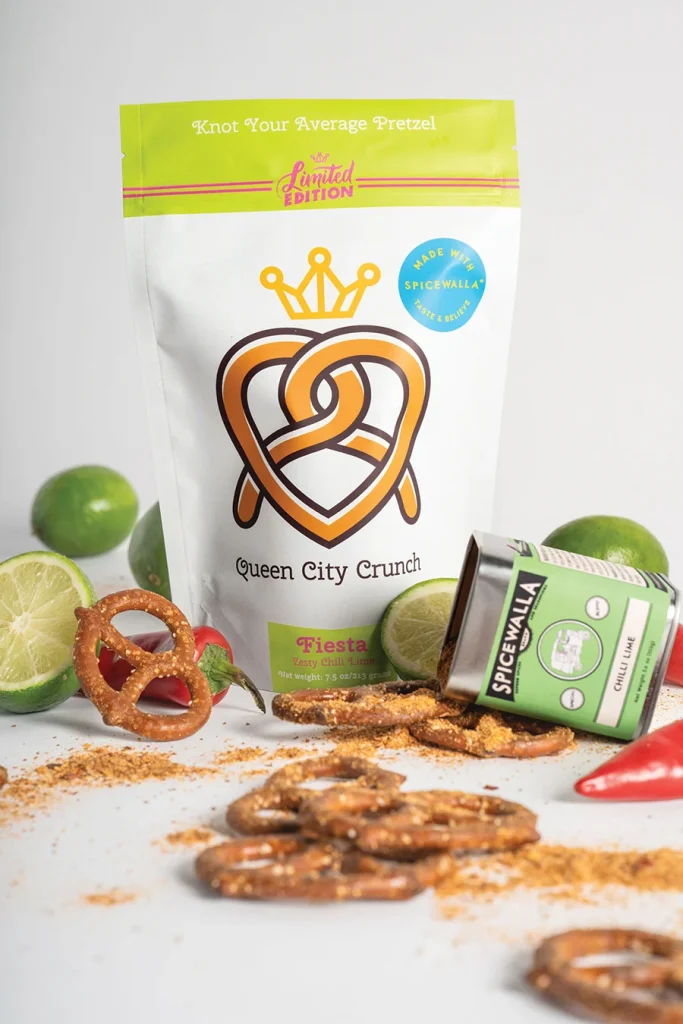
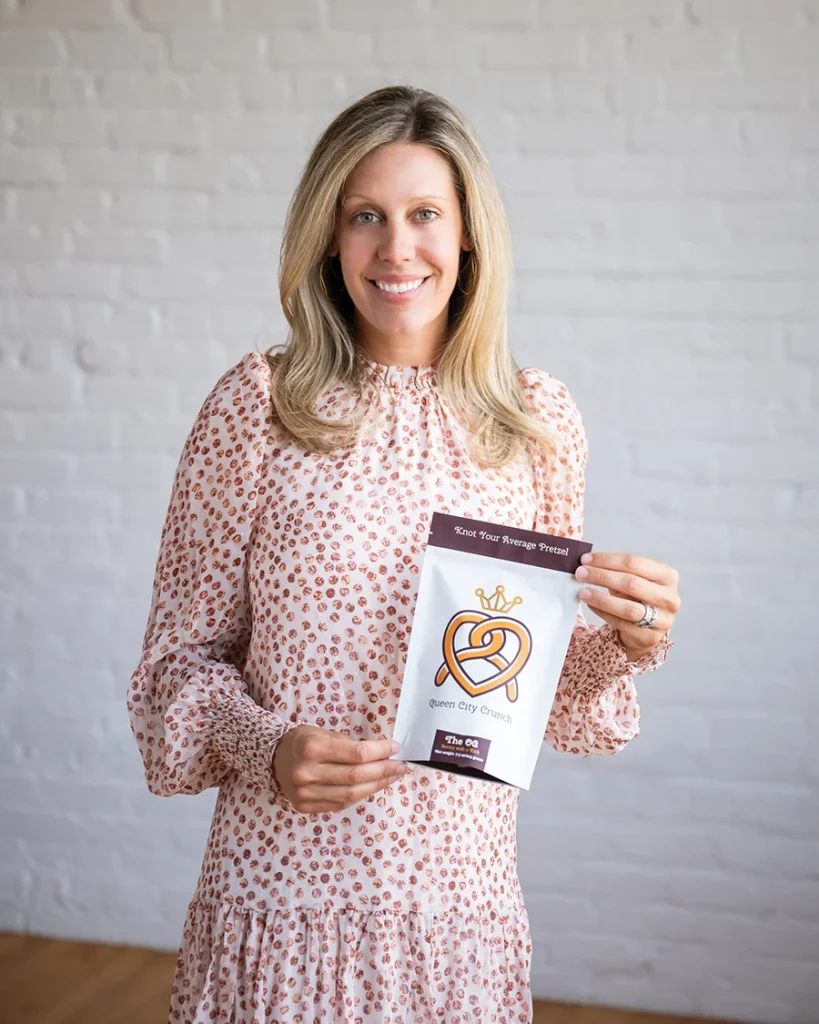
Katie Cooper, founder of Queen City Crunch. Photograph by Amanda Anderson.
Building on a family recipe
Like the Roses, the pandemic also turned out to be a time of opportunity for Katie Cooper of Queen City Crunch. Cooper got the idea to start her home-processing venture after gifting a family pretzel recipe to her wedding guests. Cooper recalls these special pretzels from family events growing up. While the ingredients are few and simple, friends and family were always vying for a taste.
In February 2021, Cooper started mixing and hand-baking small batches in her home kitchen.
“It was really easy to get certified with the Department of Agriculture, which had a lower barrier to entry with the application and inspection process,” Cooper says.
But working in her home kitchen became messy. Cooper recalls constantly cleaning up crumbs. Within two months, she moved the operation into a commercial space but continued to do the packaging in a small room over her garage. After another five months of continued growth, Cooper decided to relocate the entire business out of her home.
Her pretzels can be found on the shelves at Reid’s Fine Foods, Pasta & Provisions and other local gift shops, such as Paper Skyscraper, as well as Blumenthal Arts venues.
“I would love to keep expanding and eventually move into a larger facility, and be more of a prevalent brand and be at [more] specialty grocery stores,” Cooper says.
In the meantime, Queen City Crunch is working with Asheville-based spice company, Spicewalla, using its chili-lime seasoning to create a limited edition Fiesta blend. During the holidays, Cooper also focuses on corporate orders and gift boxes.
While her success didn’t come without challenges, Cooper encourages other food entrepreneurs to get started.
“If you’ve got a recipe that people love, give it a whirl,” Cooper says. “Don’t be afraid to begin and learn throughout the process. Don’t be afraid to ask for help or seek advice from other similar businesses … Put yourself out there and have fun.”
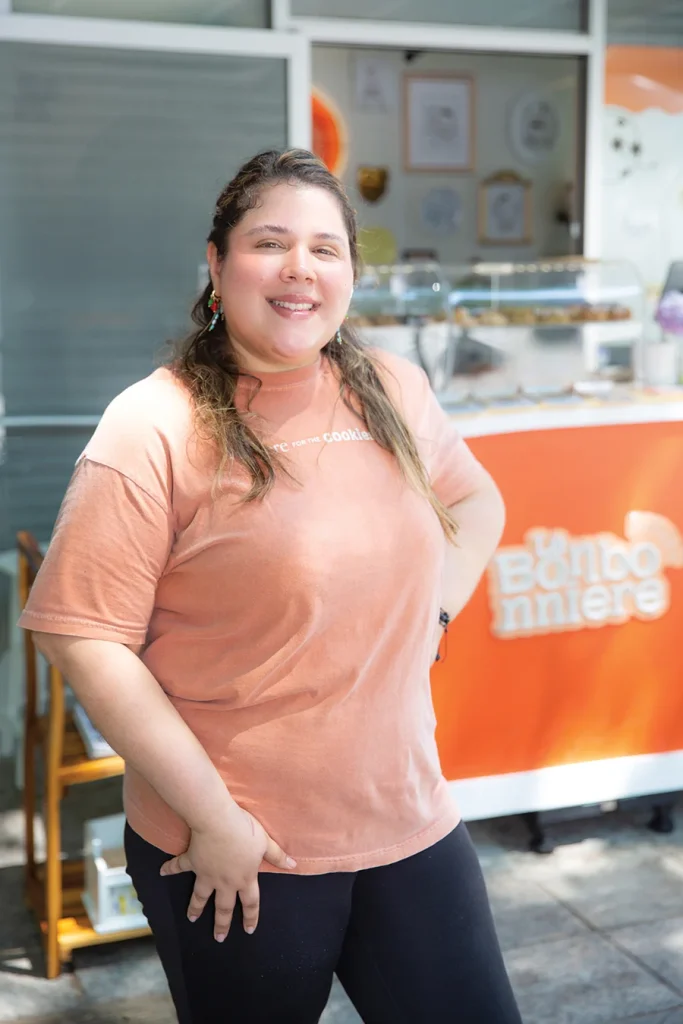
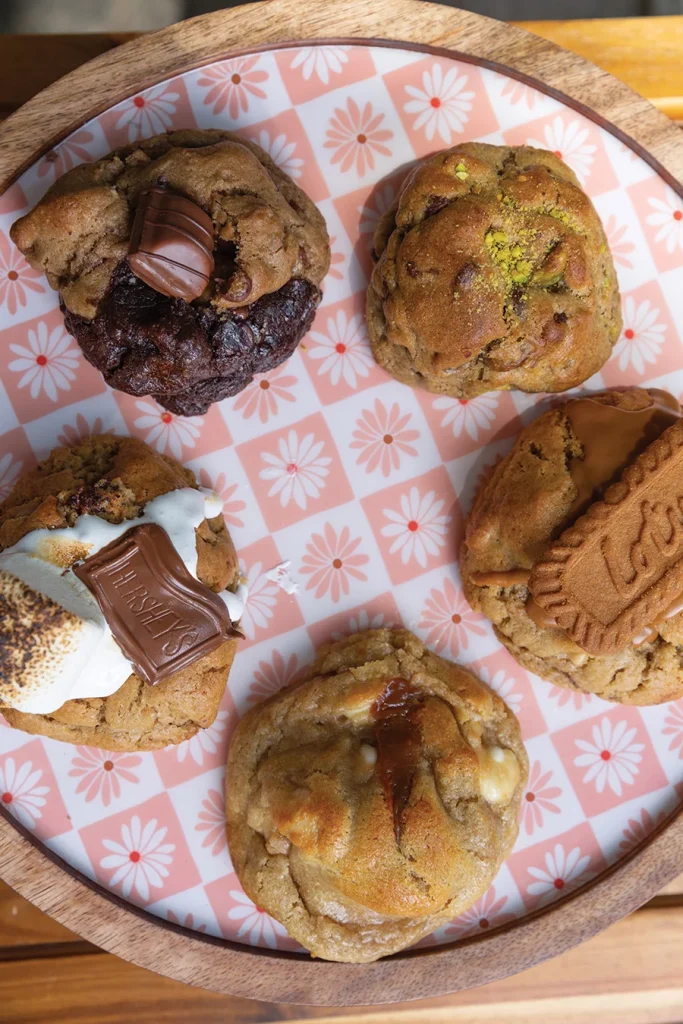
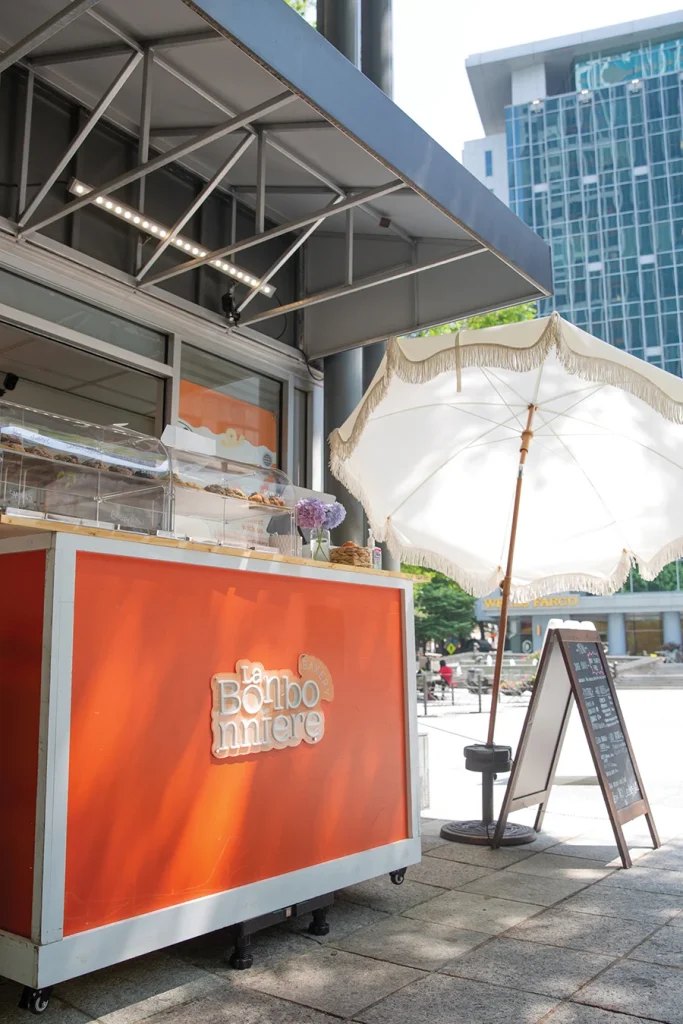
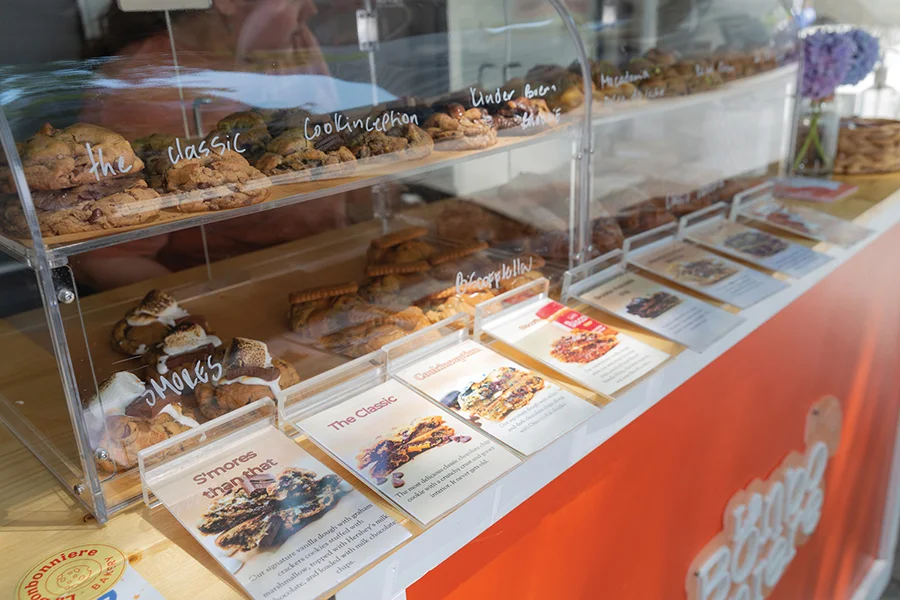
La Bonbonniere’s uptown storefront. Photographs by Justin Driscoll.
A bakery as sanctuary
Valentina Lopez took this advice and started her cookie-focused bakery, La Bonbonniere, after immigrating from Venezuela to the United States in 2021. Lopez, a culinary-school graduate who previously owned a bakery by the same name in her home country, put her passion for baking on the back burner after her son was born.
“I was home with a newborn and losing my mind. [But] while he was taking naps, I started baking cookies,” Lopez says.
Cottage-food regulations made starting a business convenient for the new mother. Instead of sharing space in a commercial kitchen, Lopez converted a room in her home into a baking studio, equipped with a professional mixer, ovens and a freezer. It became her sanctuary.
In 2023, La Bonbonniere 2.0 was created.
“This business was reborn with my baby. It was a super difficult time for me, being alone in this country and learning a new language. I did everything for him, but somehow, I made this [bakery] for myself. It was to communicate and to reconnect with myself and the things that I really truly enjoy,” Lopez says.
At La Bonbonniere, cookies are made with simple and organic ingredients — usually no more than five — and without extra sugar or corn syrup. Lopez has more than 35 flavors, with a menu of up to 12 that rotate weekly. A bestseller is the Walnutholic, made with chocolate chips, walnuts, Nutella and Ferrero Rocher. One of her favorites is the Royal Dubai, which is made with homemade pistachio butter, tahini and Godiva chocolate. She also makes a Biscoff-flavored cookie, as well as a cookies-and-cream cookie made with Oreos and stuffed with a gooey ganache.
Cookies are sold online, at the Charlotte Regional Farmers Market and at Uptown Farmers Market. La Bonbonniere also has a new uptown storefront, but Lopez still does all of the baking at home — and she doesn’t plan to change that.
“[I enjoy it] because I can take breaks to be with my toddler. I can do what I love while being with the ones that I love.”
For Lopez, La Bonbonniere is not just a business. It’s a representation of who she is and her unique story.
“It’s a reminder of the things that I’ve sacrificed to be here and the things that I went through to make this dream happen, because it’s happening and is something that I’m building every day.”
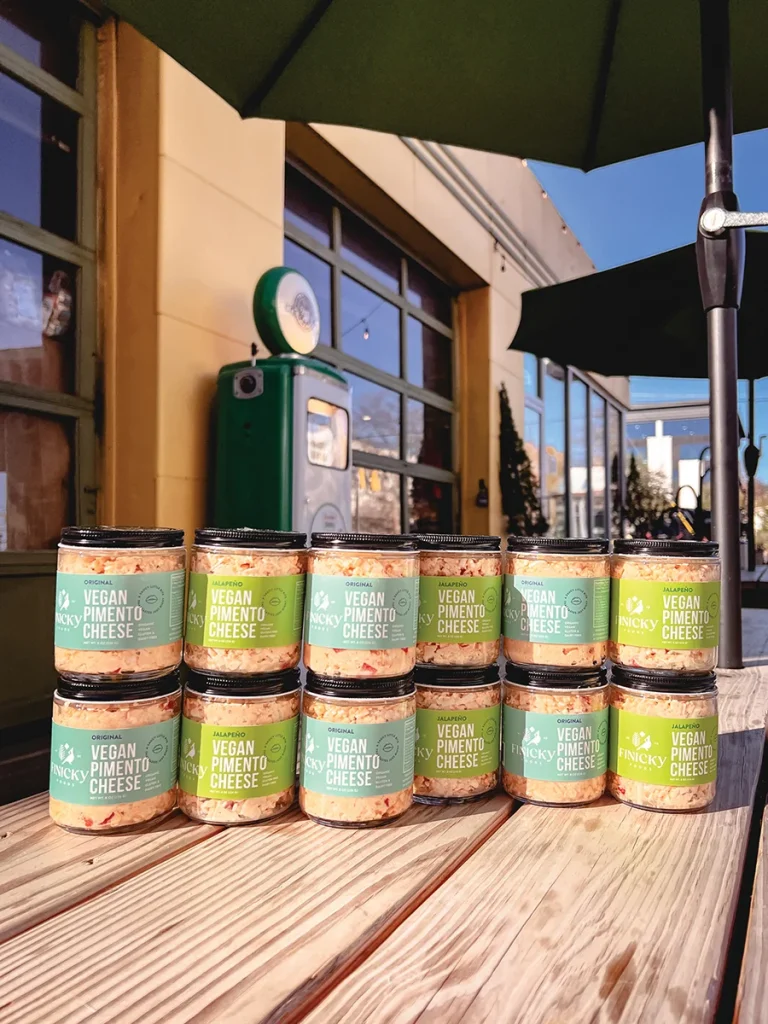

Finicky Foods founder Jessica Gaddy, right. Photographs courtesy Finicky Foods.
Campout dinners and wellness getaways
Unlike Lopez, Jessica Gaddy, owner of Finicky Foods, wasn’t able to start her business from home because of the perishable nature of her pimento-cheese line. But that didn’t stop her from figuring out another way to build her brand and start a different cottage food-inspired pursuit. Gaddy plans to convert her garage into a commercial kitchen. In the fall, she hopes to use the space to begin hosting campout dinners on her 19-acre Waxhaw property with wooded walking trails and a wildlife overlook.
Guests will reserve a spot at the Finicky Table for an all-inclusive five-course dinner and camping experience. Gaddy and her husband will rent camping gear and help any first-time campers set up at one of six campsites. Whether partaking in a beginner yoga session or unwinding in the hammock lounge, Gaddy wants to give guests the opportunity to relax outdoors and make a wellness getaway more accessible to locals.
“For us, it’s just about the simple,” says Gaddy. ”[And enjoying food made with] all real ingredients that make your tastebuds feel good and your belly feel good and your soul feel good.”
Growing a business and spreading joy
Today, Rose speaks wistfully about the early days of Team Rose Bread, when customers placed orders on social media for pickup at the carport or delivery by Rose and his daughter. He recalls manually entering addresses into Google Maps, driving to about a dozen homes and personally reaching out to customers for payment via Venmo.
“Those were sweet beginnings,” Rose says. Now orders are placed through the bakery’s website using the Shopify app, and a more typical Tuesday consists of 80-90 deliveries completed by two drivers. Pickup orders have moved from the carport door to nearby Trinity Presbyterian Church.
While aspects of the business have changed, bread still finds a way to spill out of the shop and into the kitchen, living room and hallway.
“It feels like in 2020, we brought a tiny baby dragon into our home. It was cute and pet-able, and novel and fun, and now it’s turned into this fire-breathing monstrosity that has wings that shoot out in all directions and has overtaken our home,” Rose says with a laugh.
Luckily, with the help of their children to tame the dragon, Team Rose Bread regularly serves sourdough and sandwich loaves, along with a rotating selection of English muffins, bagels, challah, cinnamon rolls, monkey bread and chocolate babka, among others. Their 10-year-old daughter shapes dough and their 12-year-old son bags the final product. On weekends, their teenage daughter helps run farmers market stalls, and their 8-year-old son, while he is still too young to help, snacks on bread and enjoys his role as the unofficial taste tester.
“[Together] we’re expressing ourselves and our family, and the way we do life, and the way we eat and the way that we celebrate food in the way that we love bread at every single meal,” Rose says. “Our business is an invitation for others to be a part of that.”
While the business has expanded, scaling is limited by equipment and space.
“We’re exploring and moving towards taking Team Rose Bread from the carport to its next iteration. We feel like there is more that we want to do, but can’t do in this space.” In the meantime, customers can anticipate the return of hot dog rolls and the unveiling of hamburger buns this summer.
For Rose, and other food entrepreneurs like Gaddy, Cooper and Lopez, their businesses are an extension of themselves and a way to share not just good food, but spread joy to their communities. SP